Enrollment Strategy


By Angela Brown, Head of Marketing
If your graduate programs start in January, the working adults you'll enroll for spring are making decisions in the next few weeks. That makes this stretch of graduate student recruitment a follow-up problem. Many of them sent one question in October, got one reply and then…crickets. The kind of follow-up that keeps them moving remembers what they asked, answers funding and schedule questions before they hold up the application, reaches them in the evening when they have time to read, and hands the hardest conversations to a person. Whew!
That's a lot to ask of a graduate office that's reading fall applications at the same time. It's also where spring enrollment gets decided. Graduate enrollment didn't grow last year: the National Student Clearinghouse Research Center found it held essentially flat in fall 2025 (down 0.3%), with international graduate enrollment down 5.9%. In a flat market, the spring applicants already in your funnel carry more weight than usual.
Why spring-start applicants go elsewhere after the first reply
They move on because the first reply came late, said something generic and turned out to be the last thing they heard. In the 2026 Halda + NAGAP Graduate Enrollment Management Trends survey of more than 350 graduate students, prospects waited an average of 3.6 days for a reply to an online inquiry. 22% waited six days or more, and only 6% heard back the same day.
But a faster auto-reply won't close that distance on its own. 76.6% of students rated a personalized response as significantly or crucially important to their decision, while 54.9% said the same about a quick one. They want an answer to the question they asked, and they'd rather wait a little bit for it than get a fast reply that ignores it.
The shortlist is also small. Students in the same survey looked at 5.1 programs on average and applied to 4.3, so one unanswered question can be enough to drop a program from the list. And 57% said they never or only sometimes spoke with an admissions counselor before applying, which means your follow-up messages are doing most of the talking.
Picture the person who asked about part-time options at 9:40 p.m. during a holiday weekend in October. By November, they're comparing your reply with three others, checking whether their employer will help pay and figuring out whether evening classes fit around a full-time job. We've written before about why adult learners seem to ghost admissions teams, and the pattern holds here: they leave when the process can't keep up with them.
More volume won't fix it either. Plenty of graduate offices already send as much email and text as their tools allow in a day. The trouble is that the next message has no idea what the last conversation was about.
How much time do spring-start applicants have left?
For a January start, usually a few weeks. Many programs close spring applications in November or December, and rolling programs often keep admitting into the holidays. In that window, an applicant has to finish the application, get transcripts and recommendations in, sort out funding and rearrange a work schedule.
The calendar is shorter than it looks. Thanksgiving week and winter break take a big piece out of it for your office. Your applicants keep making decisions through both, often with more free time than usual, and they'll notice who's still responding.
What follow-up do spring-start applicants need before the deadline?
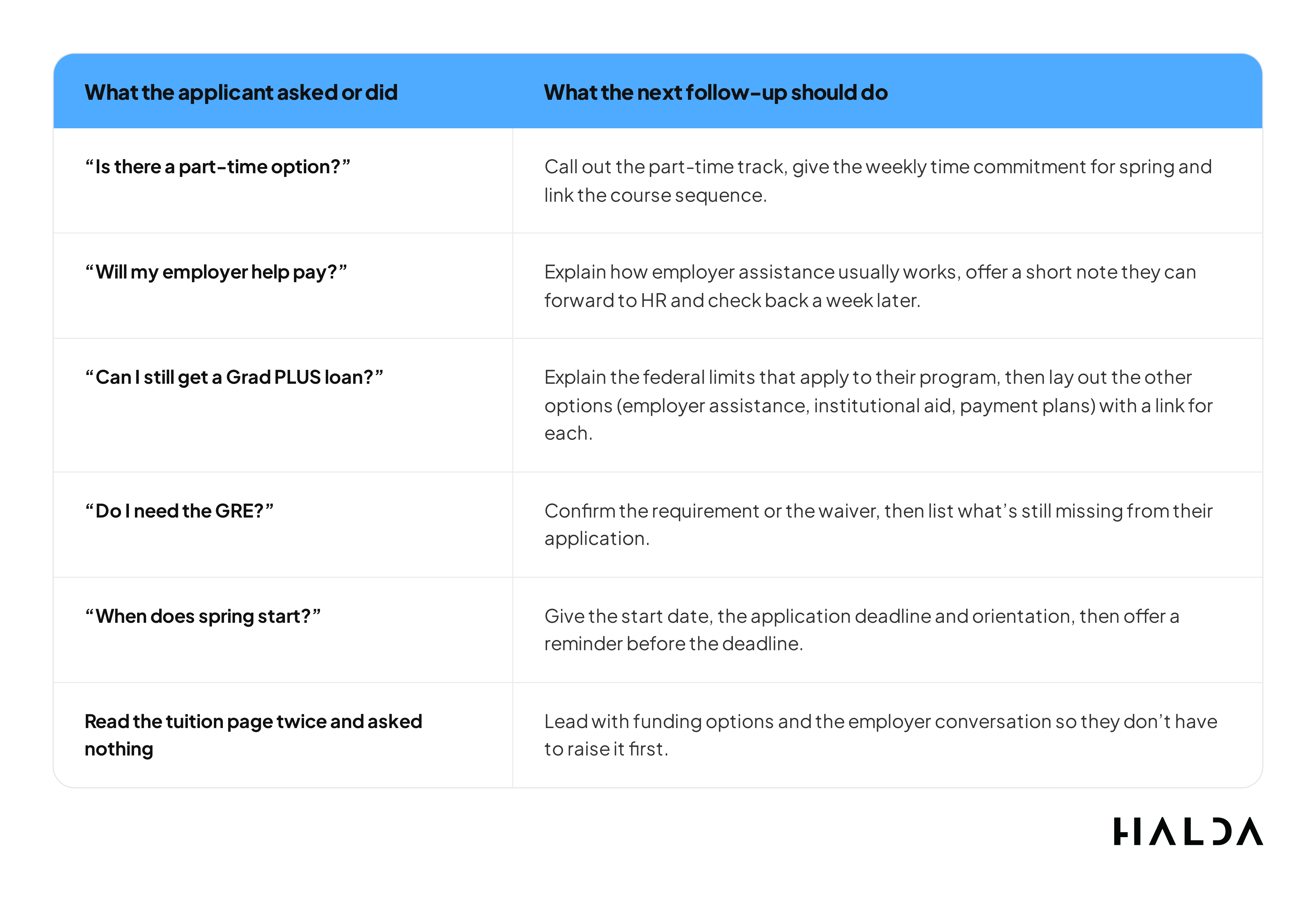
They need follow-up that picks up the conversation where it stopped, answers money and schedule questions early and reaches them during the hours they read messages. Seven things make the difference.
- Start from what they asked. If the inquiry was about part-time options, the next message is about part-time options. A second message that repeats the program brochure tells the applicant nobody read the first one.
- Get funding answered before it stalls the application. Graduate students in the Halda + NAGAP survey ranked cost fifth among decision factors, behind program strength, faculty quality and reputation. Cost still slows people down when nobody addresses it. Working adults often plan around employer tuition assistance, and under IRS Section 127, employers can provide up to $5,250 a year in tax-free education benefits. Tell applicants what their HR office will likely request, and tell them early, since approval can take weeks.
- Get ahead of the new federal loan rules. Grad PLUS ended for new borrowers on July 1, 2026, so an applicant starting a new program this spring can borrow up to $20,500 a year in federal Direct Unsubsidized Loans ($100,000 lifetime), or $50,000 a year in professional programs such as law and medicine (Federal Student Aid). Spring starters are among the first applicants to plan entirely under these limits. Nursing, physician assistant, physical therapy, social work and education programs count as graduate programs, so students in those fields fall under the lower limits. Expect questions like "Can I still get Grad PLUS?", "Does my program count as professional?" and "What covers the rest?" Answer them in writing before an applicant has to raise them, and connect anyone with a complicated situation to your aid office.
- Spell out the spring schedule. Give the start date, class nights, weekly course load, orientation date and last day to apply. A working adult can't plan a semester around the word "flexible."
- Show up after work. Working adults read messages in the evening, so a reply that hits an inbox at 2 p.m. gets read at 9 p.m., if it gets read at all.
- Use each channel for what it does best. Email carries program detail, text handles deadline reminders and missing items, and a phone call is the place for a funding question or a schedule conflict. Our 2027 graduate recruitment guide has the Halda partner data on how each channel moves conversion.
- Decide in advance when a person takes over. An applicant weighing two offers, a complicated funding situation or someone who says they're about to give up belongs with a counselor. Set that rule now so those conversations don't sit in a queue over break.
A four-week follow-up plan for January starts
Work backward from your spring deadline. If it falls in early December, Thanksgiving week lands in the middle of this plan, so move the funding step up a week.
- Four weeks out: Reopen each October and November inquiry that hasn't applied, and reply to the specific question each person asked.
- Three weeks out: Send employer-assistance details to anyone who viewed tuition or asked about cost, along with the spring class schedule.
- Two weeks out: Text applicants with incomplete applications about the one item still missing.
- Final week: Call or write personally to anyone who started an application but hasn't submitted it, and include the deadline's date, time and time zone.
- After they submit: Confirm receipt within a day and tell them when to expect a decision. Admits who hear nothing for weeks start shopping again, which is the same problem we covered in keeping graduate admits engaged before day one.
How does Halda follow up with spring-start applicants?
Halda remembers each applicant's conversation, including what they asked, which program pages they read and what they said about funding or schedule, and uses it to shape the next email, text or call. Each student gets their own campaign, built from what that person has done so far, instead of the same five-email sequence everyone else receives.
Because Halda learns with every interaction, a part-time question asked in a website chat on Oct. 9 shapes the text that goes out on Nov. 12 and the call that follows if the application stalls. Halda works alongside Slate and your other existing tools, so your counselors see the same history when they step in. Your team sets which conversations go to a person and how quickly.
Stephen Ostendorff, dean of admissions at Molloy University, put the goal plainly when his team started using Halda. He wanted students to see that his office understood their "finances, jobs, time, flexibility" and that "we know their lives are complex." (Read the Molloy story.)
If your January class is only weeks away, the checklist above is what you can do this month. Halda is for making sure next term's applicants don't depend on how busy your office is in November. Most institutions are live within 90 days, which puts summer and fall 2027 starts within reach. For the bigger picture on next year's plan, see our 2027 graduate recruitment strategy guide.
Frequently asked questions
How fast should a graduate program respond to an inquiry?
The same day when you can, and within one business day at the latest. In the 2026 Halda + NAGAP survey, graduate students waited 3.6 days on average and only 6% got a same-day reply. Relevance matters even more than speed: 76.6% rated a personalized response as important to their decision, compared with 54.9% for a quick one.
How many follow-ups should a spring-start applicant get?
There's no fixed number. A follow-up earns its place when it answers something the applicant asked or moves them past a specific step, like a missing transcript or an employer form. Repeating the brochure adds volume without moving anyone forward.
Should graduate programs text applicants?
Yes, with the applicant's consent. Text works best for short, time-bound messages such as a missing document or a deadline reminder. Keep longer program detail in email, and get opt-in before you text anyone.
What should a follow-up email to a graduate applicant include?
It should reference what the applicant asked or did, give one specific answer, name the next step with a date and offer a way to reach a person. Keep it short enough to read on a phone after work.
Before you close for break
Pull your October inquiries who haven't applied and read the last message each one received. If that message doesn't mention what they asked, it's the first follow-up to fix this week.
________________
As Halda’s Head of Marketing, Angela Brown brings more than 15 years of experience leading marketing and content teams in education and B2B SaaS. When she isn’t at her computer, you can find her reading, watching a true crime documentary, or driving her son to basketball practice.