Enrollment Strategy


By Angela Brown
Summer melt is usually talked about like an undergrad problem. An 18-year-old deposits in May, then stops responding by August. Graduate melt looks different. These are admits who have already committed, already know why they want the degree, and still drop off somewhere between the acceptance letter and orientation.
Fall 2025 enrollment data shows why this matters. Total postsecondary enrollment reached 19.4 million students, up 1.0 percent from the prior year, but that growth came almost entirely from undergrad. Graduate enrollment held essentially flat at negative 0.3 percent, pulled down by a 5.9 percent drop in international graduate students. The international decline gets most of the headlines, but the quieter risk sits with domestic, working-adult admits who commit and then stall.
For this group, melt is about three unresolved questions: will my employer actually cover this, what does my schedule look like, and is this still the smartest way to spend my tuition dollars? Answer those clearly, on a cadence built for someone with a full-time job, and you keep admits moving instead of watching them disappear.
Why Graduate Admits Go Silent After Committing
Employer Funding Questions
A lot of working adults are enrolling on the assumption that their employer will help pay for it. More than half of U.S. employers now offer some form of tuition assistance, and under IRS Section 127, employees can exclude up to $5,250 a year in employer-provided education benefits from taxable income.
That's the easy part to explain. What trips people up is everything below the surface: tenure requirements before they're eligible, whether the employer reimburses after the fact or pays the school directly, GPA minimums and payback clauses if they leave the job before a set date. When an admit can't get a fast, clear answer on what their employer will cover, they don't ask for help. They just stop responding.
Start-Date Uncertainty
Working adults are juggling project deadlines, caregiving and sometimes a partner's schedule too. When a program doesn't spell out the exact start date, how the cohort is structured, what the course load looks like, and what deferral actually requires, admits default to waiting it out. Waiting turns into not showing up, and nobody notices until it's too late to fix.
Program Comparison and ROI Doubts
Based on undergraduate recruitment trends, a common assumption is that cost drives the comparison shopping that happens after an admit commits. Halda's 2026 Graduate Enrollment Management Trends report, produced with NAGAP, found something different: enrollment professionals rank financial cost as the single biggest factor in a student's decision, but students rank it fifth, behind program strength, faculty quality and institutional reputation. Nearly half, 48 percent, said personal fulfillment is their primary motivation for pursuing graduate school, and 46 percent said they're weighing practical career outcomes against that fulfillment instead of picking one over the other.
The list an admit is comparing you against also got shorter and more decisive. Students investigated an average of 5.1 programs before applying in 2026, down from six the year before, but applied to slightly more of them (4.3 versus 4). Fewer programs make the shortlist, and once a program is on it, the student is more likely to follow through. That raises the stakes of staying on the list once summer sets in.
Even after committing, plenty of admits are still running the math on their own: is this the best use of a tuition benefit that could shrink or disappear next year? Silence after commitment usually means an admit is comparing options or stuck on a funding question. It doesn’t necessarily mean they've lost interest.
That mismatch between what professionals assume drives the decision and what students really weigh doesn't mean cost doesn’t matter to a working-adult balancing an employer benefit against a shrinking paycheck. It means a summer plan built entirely around funding logistics, without reinforcing why the program itself is worth the trouble, is answering half the question.
Summer Engagement Built for Working Adults
Adult-centric engagement starts with a simple idea: respect their time, and make every message earn its place in their inbox.
A few principles guide your strategy:
- Cadence matches their rhythm. Fewer, higher-value touches, timed for early-week mornings or midweek lunch breaks, not evenings or weekends.
- Channel matches the task. Email carries detail: cost breakdowns, benefit guides, syllabi. SMS handles quick confirmations and two-way check-ins. Voice steps in for the harder conversations, like walking through a funding scenario or a start-date conflict.
- Assume they're async. Not everyone can take a live call at 2 p.m. on a Tuesday. Give people an easy way to reply when they can, not just when you call.
- Relevance beats raw speed. In the same 2026 NAGAP report, 77 percent of graduate students rated a personalized response as significantly or crucially important to their decision, compared with 55 percent for a fast one. A tailored reply a day later outperforms a generic auto-response sent in minutes.
The summer window breaks into four stages, each with its own goal and primary channel:
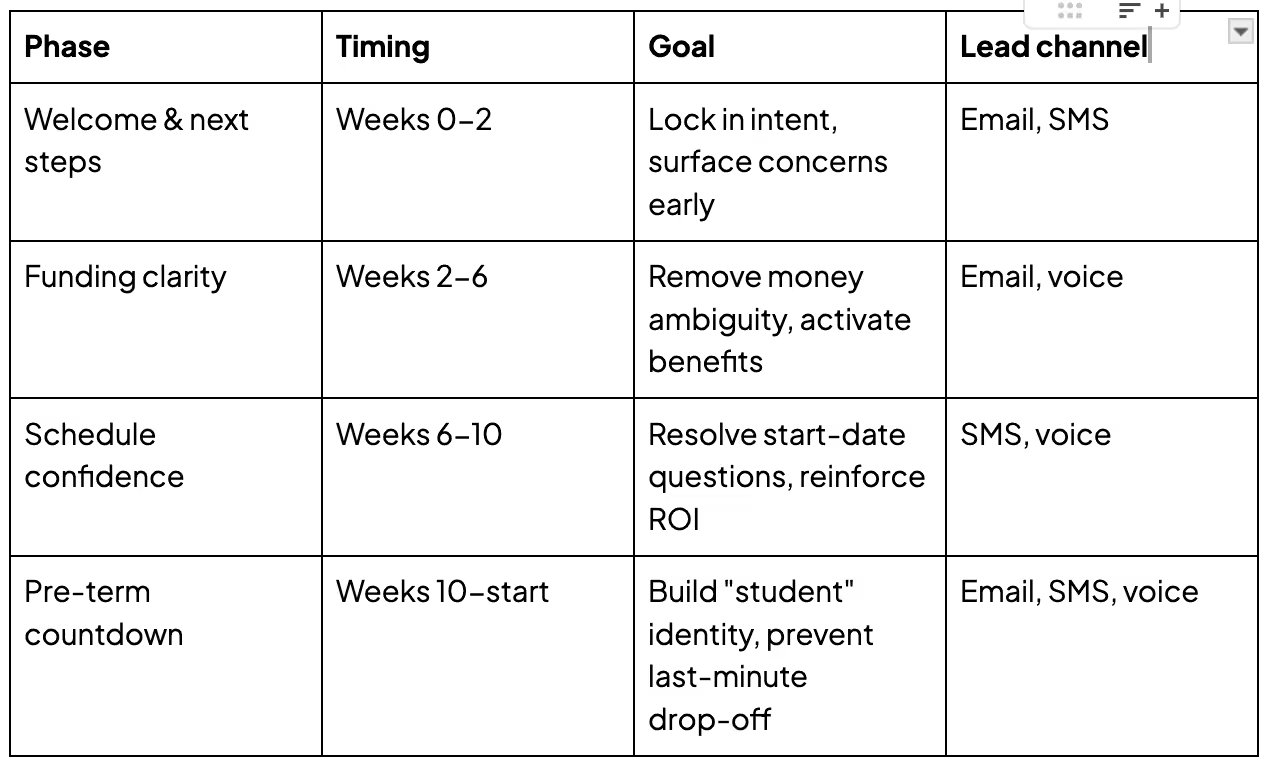
In practice, that means a short "you're in, here's what's next" email in week one, paired with a quick SMS check-in asking what's on their mind (cost, schedule, or something else). By week two, follow with a plain-language guide to using an employer tuition benefit, including a template admits can forward straight to HR. Voice comes in for anyone who hasn't opened the funding emails or flagged cost as a concern; those calls should walk through total cost and payment timing, not repeat what the email already said.
Once funding is settled, shift to schedule. A short "what your first eight weeks look like" email, paired with an SMS micro-poll ("A: fall as planned, B: defer a term, C: I need to talk it through") does more to surface a stuck admit than another generic reminder. Save voice outreach for admits who haven't finished onboarding steps or who've flagged a scheduling conflict, and use the call to build a real plan together instead of just checking a box.
By the final stretch, the goal changes from information to identity. A welcome note from the program director, a first-week checklist, and two or three friendly reminders about orientation do more good here than another data-heavy email. Save a personal call for admits who haven't responded in 30 days or more. That's the group most likely to no-show.
Follow-Up That Respects Their Schedule
Cadence. One to two substantive emails a week, each with a clear reason to open it. One to three short SMS messages a week, always with an opt-out, always under about 160 characters. One or two planned voice calls during the funding and pre-term windows, with a text or email recap afterward for anyone who missed the call.
Timing. Skip late nights and weekends unless someone's asked for it. Midweek, midday touches work best, and early-week messaging fits planning-heavy content. A subject line that signals concrete value ("Your employer tuition benefit checklist") outperforms a generic check-in every time. Offer an easy out: "Prefer email? Reply EMAIL and I'll send the details," or a link to grab a 15-minute slot instead of a cold call.
Escalation. If an admit skips two or three emails in a row, switch to SMS with a different hook. If they respond to texts but not email, lead with text and save email for formal documents. If they mention cost or schedule stress in any channel, move to a live advisor call. For admits who are fully funded through an employer but haven't submitted the paperwork, skip automation and go straight to a personal call plus a follow-up email.
How Halda Supports Grad Outreach Across Channels
This is where a platform that learns with every interaction earns its keep. Every touch an admit has across web, email, SMS and voice builds on the last one, so a funding conversation that starts by phone doesn't reset when the follow-up lands by text.
A single timeline for each admit. Halda orchestrates the full journey, web, email, SMS and voice, from a single record instead of four disconnected tools. Behavioral signals like email opens, link clicks and form completions adjust the channel and frequency automatically, so an admit who's ignoring email starts hearing from you by text instead.
Segmentation built for grad admits. Group outreach by funding path (employer benefit, self-pay, loans), start-term confidence (confirmed versus considering deferral), and engagement level (responsive versus silent), then deliver content that matches: funding guides for employer-supported admits, ROI data for the comparers, flexible-start options for anyone juggling a job.
Preferences built in, not bolted on. Manage opt-ins and opt-outs across every channel, set quiet hours, and track response rates and melt by segment so the cadence keeps improving instead of guessing.
Yield you can show leadership. Track onboarding completion, funding confirmation rate, and summer-to-fall conversion by segment, so the case for respectful, data-driven engagement is a concrete number in the board deck, not a gut feeling.
If your team already has a plan for reading yield trends and closing deposit gaps or preventing undergraduate summer melt, this is the graduate-specific layer on top of it.
Halda's 2026 Graduate Enrollment Management Trends report gives that layer a clear brief: graduate students waited an average of 3.6 days for a response to an online inquiry, and 41 percent said they rarely or never received a personalized message, even though 77 percent said personalization significantly influences their decision. That's the exact disconnect a system built to remember every prior interaction is meant to close. Build for a group that answers to a boss, a family and a budget before they answer to an admissions office.
FAQ
What causes graduate summer melt? Graduate melt usually traces back to three unresolved questions: whether an employer will cover tuition, what the start-date and schedule look like, and whether the program is still the smartest financial choice. Admits who stop responding are usually stuck on one of these, not losing interest in the degree itself.
How is graduate melt different from undergraduate melt? Undergraduate melt is often driven by financial aid uncertainty and a lack of family knowledge about the process. Graduate melt, especially among working adults, is driven more by employer funding logistics, competing work and family obligations, and active comparison shopping against other ways to spend the same tuition dollars.
How often should we contact a graduate admit over the summer? As a starting point, one to two emails and one to three texts a week, plus one or two planned voice calls during the funding and pre-term windows. Watch response patterns and let the admit's behavior, not a fixed schedule, decide when to shift channels.
Graduate admits aren't ghosting you. They're waiting on answers you can give them, on a schedule that fits a life that doesn't pause for summer.
_____________________________________________________________________________________________________________
Sources cited in this post
- Halda + NAGAP, 2026 Graduate Enrollment Management Trends (n=359 students, 83 enrollment professionals), Apr. 2026
- National Student Clearinghouse Research Center, Fall Undergraduate Enrollment Shows Overall Growth Despite Decline at Private Colleges, Jan. 2026
- IRS, Employer-Offered Educational Assistance Programs Can Help Pay for College
- College Transitions, The Complete Guide to Employer Tuition Reimbursement, 2026
________________
As Halda’s Director of Marketing, Angela Brown brings more than 15 years of experience leading marketing and content teams in education and B2B SaaS. When she isn’t at her computer, you can find her reading, watching a true crime documentary, or driving her son to basketball practice.