Enrollment Strategy

By Angela Brown
Graduate enrollment management is harder than it was a year ago. Not harder in a vague, "things are changing" way. But in specific, measurable ways that show up in your funnel, your messaging, and the delta between what your team believes and what students actually do.
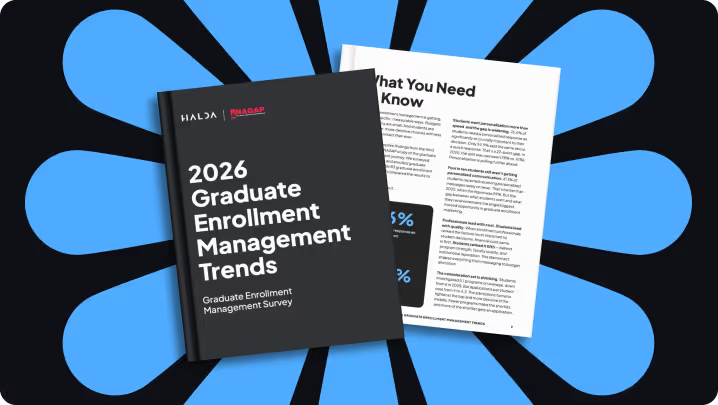
The 2026 Halda + NAGAP Graduate Enrollment Management Trends report is built on survey data from 359 prospective and enrolled graduate students and 83 enrollment professionals. It's our third annual study, and the pattern is getting harder to dismiss.
Here are the key findings.
Students Want Personalization, But They're Still Not Getting It.
This is the biggest finding, and it's been the biggest finding for three years.
76.6% of students rated a personalized response as significantly or crucially important to their enrollment decision. Only 54.9% said the same about a quick response. That's a 22-point gap — and it's wider than it was in 2025.
The counter-intuitive part: enrollment professionals rated quick responses and personalized responses as nearly equal in importance. Students clearly disagree.
A tailored response in 30 minutes beats a generic auto-reply in 30 seconds. The data is unambiguous about this, and your outreach strategy should be too.
What makes this worse: 41.1% of students say they receive personalized messages rarely or never. That's down from 59% in 2025, which is real progress. But 4 in 10 students are navigating one of the biggest decisions of their lives and feeling invisible to the institutions they're considering.
When personalization does happen, it works. 78.9% of students who received a personalized admissions experience said it helped them decide where to apply. Half of them strongly agreed. The delivery is the problem, not the strategy.
Your Team Thinks Students Care About Cost. Students Disagree.
This is also where we see a massive difference between undergraduate and graduate prospective students. When enrollment professionals ranked the factors most important to student decisions, financial cost came in first. Students ranked it fifth, behind program strength, faculty quality, and institutional reputation.
Read that again.
This disconnect impacts everything: how you write your emails, what you put on your website, what your admissions counselors lead with. If your messaging is built around cost and aid packages when students are really asking "Is this program strong? Who are the faculty? Will this institution's name mean something on my resume?" — you're answering the wrong question.
47.7% of students said personal fulfillment is their primary motivation for pursuing graduate school. Graduate students are making identity decisions. Cost is a factor, but it’s not the driver.
Most of the Journey Is Invisible to You
Only 13.3% of students said they always spoke with an admissions counselor before applying. 16.7% never did. The largest group — 40% — said "sometimes."
This means enrollment teams are being evaluated by students they've never spoken with.
67% of students first discovered programs through internet search; 60% said the institution's website was the very first place they went after starting their search; and 73.3% weren't planning to enroll at their undergraduate institution, meaning most of them have no prior relationship with you at all.
They're judging you cold, through your search presence, your website, and your content. If those aren't doing the job, you're losing students before you ever get a chance to talk to them.
The Funnel Is Getting Tighter
Students investigated an average of 5.1 programs in 2026, down from 6 in 2025. But they applied to more — 4.3 programs on average versus 4 in 2025.
The shortlist is shrinking. Once students narrow their options, they're more decisive, and this means fewer second chances. If your institution doesn't make the initial cut — in search, on your website, in your first piece of outreach — you may not get another shot.
Your Data Access Problem Is Getting Quantified
This one is new in 2026, and it's worth calling out.
68.7% of graduate enrollment professionals lack comprehensive access to their own website data. Only 4.8% have full visibility into website traffic and engagement metrics. 53% need approval from another department just to update admissions web content.
The teams responsible for driving enrollment through digital channels can't fully control or measure those channels. That's a structural problem — and making the internal case for better data access is as strategic as any campaign you'll run this year.
Get the Full Report
These findings are the starting point. The full 2026 Halda + NAGAP Graduate Enrollment Management Trends report goes deeper on every finding: response time data, what students remember most about their enrollment experience, year-over-year trend analysis, and six specific actions you can take right now without a bigger budget.
________________
As Halda’s Director of Marketing, Angela Brown brings more than 15 years of experience leading marketing and content teams in education and B2B SaaS. When she isn’t at her computer, you can find her reading, watching a true crime documentary, or driving her son to basketball practice.