Marketing Strategy


By Angela Brown, head of marketing, Halda
If you’re still treating search like it works the way it did in 2023, listen up.
On May 19, Google announced at I/O 2026 that AI Mode now has more than one billion monthly users, with queries more than doubling every quarter since launch. Google also rolled out the biggest upgrade to the search box in over 25 years, replacing a simple text field with an AI-powered interface that anticipates intent, accepts images, files, video, and Chrome tabs as inputs, and can build custom interactive answers on the fly. Google now runs information agents that operate in the background, 24/7, monitoring and summarizing topics for users so they never have to come back to a results page.
Translation for higher ed: a prospective student researching your tuition, your application deadlines, or how your nursing program compares to a competitor's may never click a link to find out. Google's AI will tell them, sometimes with a generated mini-app, often without ever sending them to your site.
That's the new front door. And many institutional websites aren't ready for it.
This piece covers what changed, why it matters more for higher ed than most industries, where you're most exposed, and a 30/60/90 day plan to protect visibility and conversion. We'll also walk through what one Halda partner, the University of Montana, is already doing about it.
What did Google announce?
The headline is AI Mode, but the substance is bigger than that. Three things matter most to you.
1. AI Mode is the default experience now, not a feature. Google upgraded AI Mode globally to its newest Gemini 3.5 Flash model and reimagined the search box itself. Users now describe what they need in natural language, and Google synthesizes an answer from across the web in real time. The classic ten blue links still appear, but they're no longer the primary surface a user looks at.
2. Search agents do the searching for you. Google's new information agents intelligently look across everything on the web, like blogs, news sites and social posts, plus the freshest data to monitor topics on a user's behalf. A high school junior who tells Google to "let me know when good business programs in the Midwest update their application requirements" will get an alert. They will not visit your website to find out.
3. Generative UI replaces traditional results pages for complex queries. Google can now build custom layouts, assembling components (like interactive visuals, tables, graphs or simulations) in real-time. A parent comparing financial aid offers across three schools may see a side-by-side affordability table that Google generated from your site's content, with your institution as one cell in a grid.
The common thread is this: Google is positioning itself as the answer layer. Your website becomes the data source. And data sources don't get clicks, they get citations.
Why This Hits Higher Ed Harder Than Most
Higher ed is uniquely exposed to AI search for four reasons.
1. Your buying journey is long and question-heavy. A prospective student asks Google dozens of questions across two or three years, about majors, careers, cost, location, transfer credits, housing, and outcomes. Those questions are exactly the kind AI Mode is built to answer in one shot.
2. Your content is fragmented across departments. Academic schools, financial aid, admissions, residence life, and dozens of program pages each maintain their own copy. AI systems struggle to identify a canonical source when five pages on your site give five slightly different answers to "what does it cost to attend?"
3. Your owned channels might be underbuilt. A lot of institutions still rely on organic search and inquiry forms as the primary intake mechanism. When organic traffic slides, there's no second motion ready to absorb the loss.
4. Your competitors are catching up faster than you think. The institutions that have already invested in structured content, FAQ schema, and Q&A formatting are showing up in AI-generated answers. The ones that didn't are watching their share of voice decline, with no clear signal in their analytics dashboard.
What's at stake if you wait?
The click loss is documented. Pew Research Center tracked 68,000 real searches and found users clicked on a traditional result 8% of the time when an AI summary appeared, compared to 15% without them, a 46.7% relative reduction. Seer Interactive's longitudinal data tells a similar story: organic click-through rates for informational queries with AI Overviews fell 61% from mid-2024 to late 2025, while even queries without AI Overviews saw organic CTRs fall 41%.
Higher ed admissions, tuition, financial aid, and program questions sit squarely in the category most likely to trigger an AI summary. So the practical risk for institutions that wait looks like this:
- Inquiry forms see fewer completions, because fewer people are arriving on a page where the form exists.
- Paid spend rises to backfill the lost organic demand, with worse ROI as competition for paid clicks intensifies. (We wrote about how to make better paid and channel choices in our budget guide for 2026.)
- Brand visibility in AI-generated answers skews toward whichever competitor structured their content best, regardless of program quality.
- Your dashboards keep showing decent traffic numbers for a while, because the decline is gradual and uneven by page type.
That last point is the trap. Visibility in AI search is hard to measure with the tools most institutions use. Rankings can look fine on traditional position trackers while your presence in the answer layer collapses. If you're waiting for the dashboard to tell you something is wrong, you're already 18 months behind.
Where You're Most Exposed
Some pages and channels will feel this faster than others. In rough order of urgency:
- Tuition, cost of attendance, and financial aid pages. These get the most AI-summarizable queries. Parents asking "what does it cost to attend X?" are getting answered directly.
- Application and admissions pages. Deadline checks, requirements, transfer policies, and process FAQs are prime candidates for AI extraction.
- Program and major pages. Career outcomes, curriculum, prerequisites, and ROI questions all funnel through AI Mode now.
- Graduate admissions content. Specialized programs face especially high competition for AI visibility.
- Event and visit pages. Quick logistical queries about open houses and tour signups get answered in-line.
- FAQ and policy pages. The format AI loves most, and often the most neglected.
- Departmental and school-level pages. Often inconsistent with institutional messaging, making them hard for AI to interpret confidently.
You're also exposed if your campaign destinations are generic. If your paid, email, and SMS programs all dump prospects onto your homepage or a thin program landing page, you'll convert a smaller share of the traffic you do get. That problem worsens as AI search shrinks the top of your funnel.
What does “good” look like now?
The solution has two parts: getting your content cited in AI answers, and building owned channels that don't depend on Google sending you traffic at all. Holding the line on enrollment means doing both.
One platform replacing three or four
Many institutions pay separately for a chatbot, an SMS tool, an email platform, and sometimes a website personalization vendor on top. The data lives in four places, so none of the tools know what the others did. Every channel starts the student conversation from scratch.
Halda was built to replace that stack with one engagement layer that remembers every interaction across web, email, SMS, and voice, then personalizes the next one. Our Always-On Campaign Agent runs the proactive outreach Google can't and won't do for you. Every interaction is aware of the last, which is the difference between a chatbot and a compounding enrollment system.
Consolidation matters more in an AI search world, not less. When you lose organic traffic, the channels you own have to work harder. Stitching together four vendors to do that is slow, expensive, and operationally fragile.
Content built for the answer layer
Generative engine optimization, or GEO, is the discipline of making content easier for AI systems to interpret, cite, and reuse. It's an extension of SEO, not a replacement. The fundamentals overlap, but the formatting is different, and the goal is to show up in the answer, not just the link list.
For higher ed, good GEO content has five traits:
- One clear question per section, with the answer in the first one or two sentences.
- Direct, factual answers before context or caveat. AI systems extract the first complete answer they find.
- Tables for tuition, deadlines, requirements, comparisons, and outcomes. Structured data is easier to pull cleanly.
- FAQ blocks on every high-intent page. These are extraction-friendly and trust-building.
- Strong trust signals: accreditation, named faculty, outcomes data, third-party rankings, and student proof.
A partner already doing this work
At the time of this writing, The University of Montana is running a live GEO pilot on academic program pages. Their approach: AI-focused intro paragraphs with tight keyword strategy, three to five FAQs built around questions students are asking AI search engines, and structured data schema on the back end.
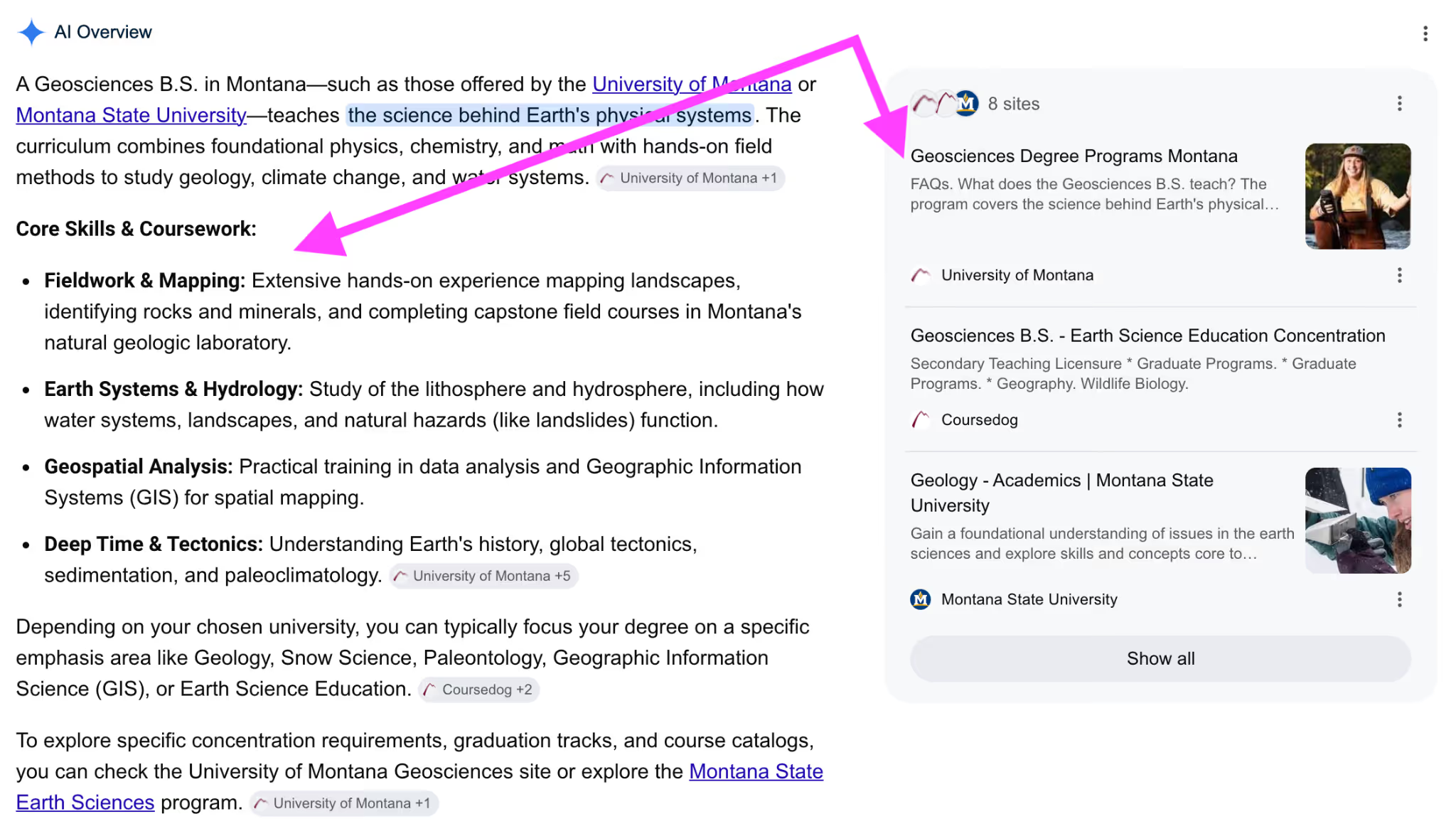
About a month in, AI search tools started citing the content they wrote, in some cases verbatim. Montana plans to roll this approach out across the rest of their program catalog through the summer and fall.
Montana also tested a different idea on the conversion side. Their GrizzQuiz, a persona-based quiz that helps prospective students discover "what kind of Griz" they are, converted at 17.25%. By comparison, their broad digital landing page campaign, which drove more than 100,000 views, came in at 4.21%. Same audience, very different conversion outcome, driven by a destination built specifically to convert instead of inform.
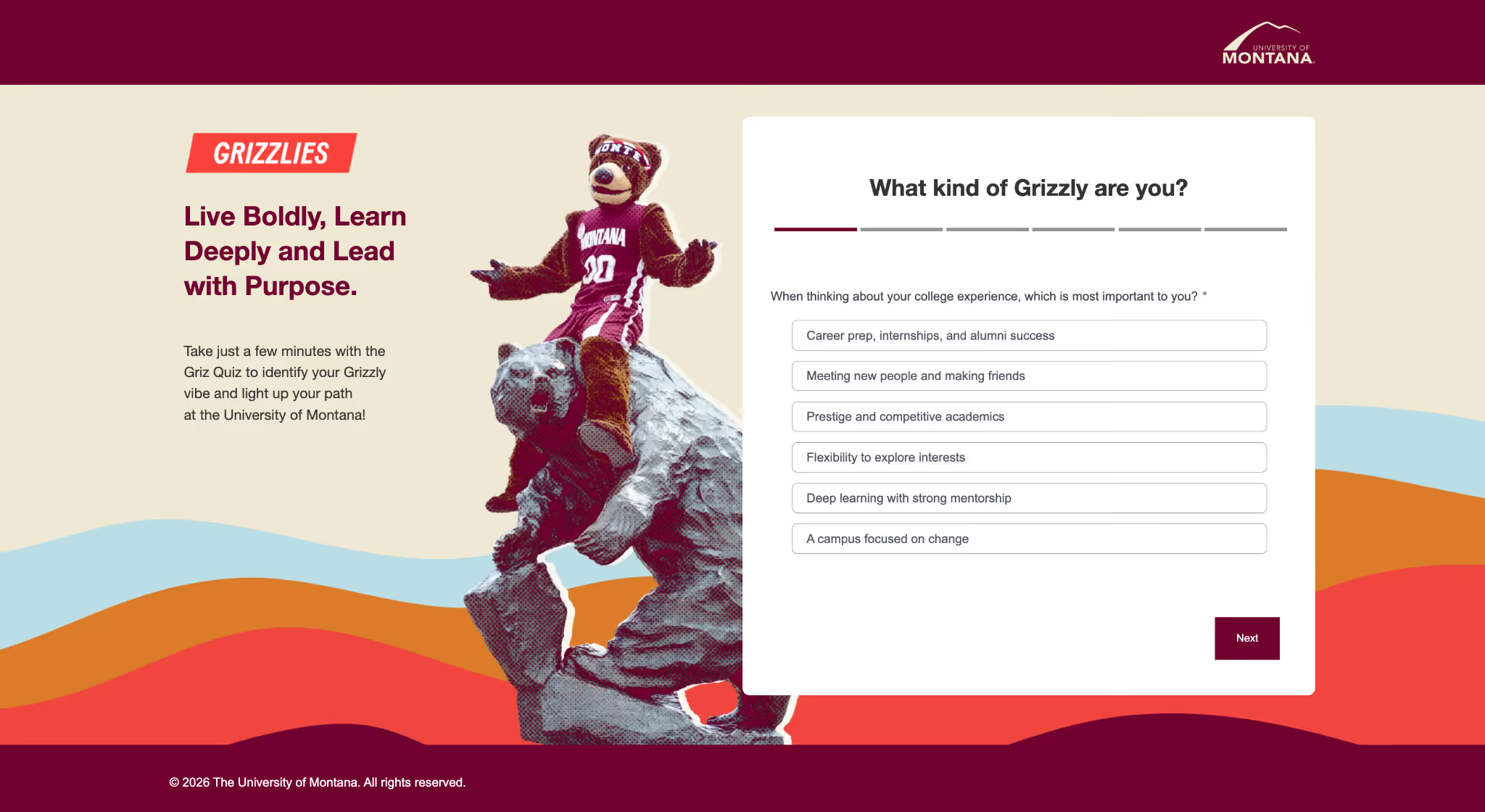
The lesson: GEO and channel design work together. Show up in the answer, then send the click to a page designed to do something with it.
You can watch Stephanie walk through the full Montana playbook in our May webinar recording.
The 90-Day Playbook
Now here are three phases for you to tackle this in the next 90 days. Don't skip the audit.
Days 1–30: Diagnosis and Quick Wins
The goal here is to find your biggest exposures and execute visible fixes within four weeks.
- Audit the top 25 to 50 pages that influence inquiries and applications. Pull traffic, conversion, and current ranking data for each.
- Map the top 30 to 50 questions prospects, parents, and transfers actually ask. Check whether each one has a clear answer on a single, canonical page.
- Compare your AI visibility to two or three direct competitors. Run the same prompts in AI Mode and ChatGPT. Note where you show up and where they do.
- Fix the obvious issues on priority pages: stale copy, missing FAQs, weak titles, broken internal links, unclear headings.
- Add or improve schema markup on tuition, admissions, program, and FAQ pages.
- Inventory your current email and SMS programs. Identify the three to five journeys that drive the most enrollment value.
- Flag landing pages currently used for paid and email campaigns that are underperforming. Generic destinations are a fast win to replace.
Days 31–60: Rebuild and Reinforce
This phase converts diagnosis into structural upgrades. Instead of rewriting your whole site, you're rebuilding the 20 pages that matter most.
- Rework core pages into Q&A formats. Headings become questions. Answers come first.
- Create canonical fact pages for tuition, deadlines, requirements, and outcomes. One source of truth per topic.
- Add FAQ sections to your most visited and most conversion-critical pages.
- Expand program pages with named faculty, career outcomes, alumni data, and clear application paths. Borrow the Montana playbook: AI-focused intro paragraphs, three to five FAQs per program, schema on the back end.
- Build supporting content for high-intent topics like transfer credit, ROI, affordability, and next steps.
- Launch or refine email journeys for inquiry-to-application, visit-to-application, and stalled-prospect re-engagement. (See our piece on why simulation outperforms A/B testing for how to build those journeys without burning cycles on tests that don't go live.)
- Stand up SMS workflows for visit reminders, application status updates, and quick Q&A on deadlines and requirements.
- Rebuild paid and email landing pages around conversion: one headline, one offer, one CTA. Test against your existing pages.
Days 61–90: Systematize
Phase three turns a one-time cleanup into a repeatable operating model.
- Publish a content governance process with named owners, review cadences, and update standards for every priority page.
- Build a GEO content calendar around your enrollment cycle. Map content to the moments when each audience is asking specific questions.
- Set up a monitoring dashboard that tracks rankings, AI visibility, page-level conversion, email and SMS performance, and landing page ROI by campaign.
- Train content owners across schools and departments on question-based writing, basic schema, and landing page best practices.
- Establish a refresh cadence so priority pages stay current as policies, programs, and deadlines change.
- Review competitor AI visibility quarterly. Use the data to prioritize the next round of content investment.
Done well, the 90-day cycle becomes the new operating rhythm. Audit, rebuild, systematize, repeat.
Your First Move This Week
If you're a vice president of enrollment or marketing reading this, the first move is the audit. Find your top 25 pages, your top 30 student questions, and your three biggest competitors in AI Mode. That's a week of work and it tells you everything you need to know about how exposed you are.
We built a downloadable GEO audit template to walk your team through that exact process. Download the GEO Audit Template here.
If you'd rather see how Halda runs the rest of the playbook across web, email, SMS, and voice, with every channel aware of every other one, book a demo and we'll show you what your full-funnel motion could look like by fall.
________________
As Halda’s Director of Marketing, Angela Brown brings more than 15 years of experience leading marketing and content teams in education and B2B SaaS. When she isn’t at her computer, you can find her reading, watching a true crime documentary, or driving her son to basketball practice.
.avif)