Enrollment Strategy


Two weeks before Nov. 1, your admissions team can still automate three things that decide how many early decision files arrive complete: deadline reminders timed to each student's status, follow-up on missing documents and personal nudges by email, text and voice. Each one takes repetitive work off counselors during the busiest stretch of the fall, and none of them requires hiring more staff.
The timing matters because early decision is binding, so admitted ED students enroll at rates close to 100%. An ED file that gets stuck in late October is about the closest thing to a sure enrollment you'll ever lose.
Early rounds keep getting bigger, too. Through Nov. 1, 2025, Common App reported that 962,284 first-year applicants had already submitted more than 4.7 million applications to 916 member colleges, 10% more applications than at the same point the year before. That's a lot of files hitting at once, right when your team's inbox starts to feel like a group project nobody else showed up for.
What can your team still automate two weeks before early decision deadlines?
You can still automate reminders, missing-document follow-up and channel-specific nudges, because each one uses data you already have. Your CRM knows who started an application, who submitted and which checklist items are still open. The work is turning that status into the right message for each student before the clock runs out.
- Last-mile reminders go to students who started an application but haven't submitted, with the one or two sections they have left.
- Students who submitted but have open checklist items get missing-document follow-up that describes the item and the person who has to provide it.
- Nudges by email, text and voice match the message to the channel, so a short deadline alert lands as a text while a detailed checklist stays in email.
Which deadline reminders should go out before Nov. 1 and Nov. 15?
Reminders move files along when they match where each student stands. A student with two essays left needs a different message than a student waiting on a parent's signature.
Here's a two-week sequence your team can build this week in the tools you already use, then reuse for Jan. 1 and Jan. 15 deadlines.
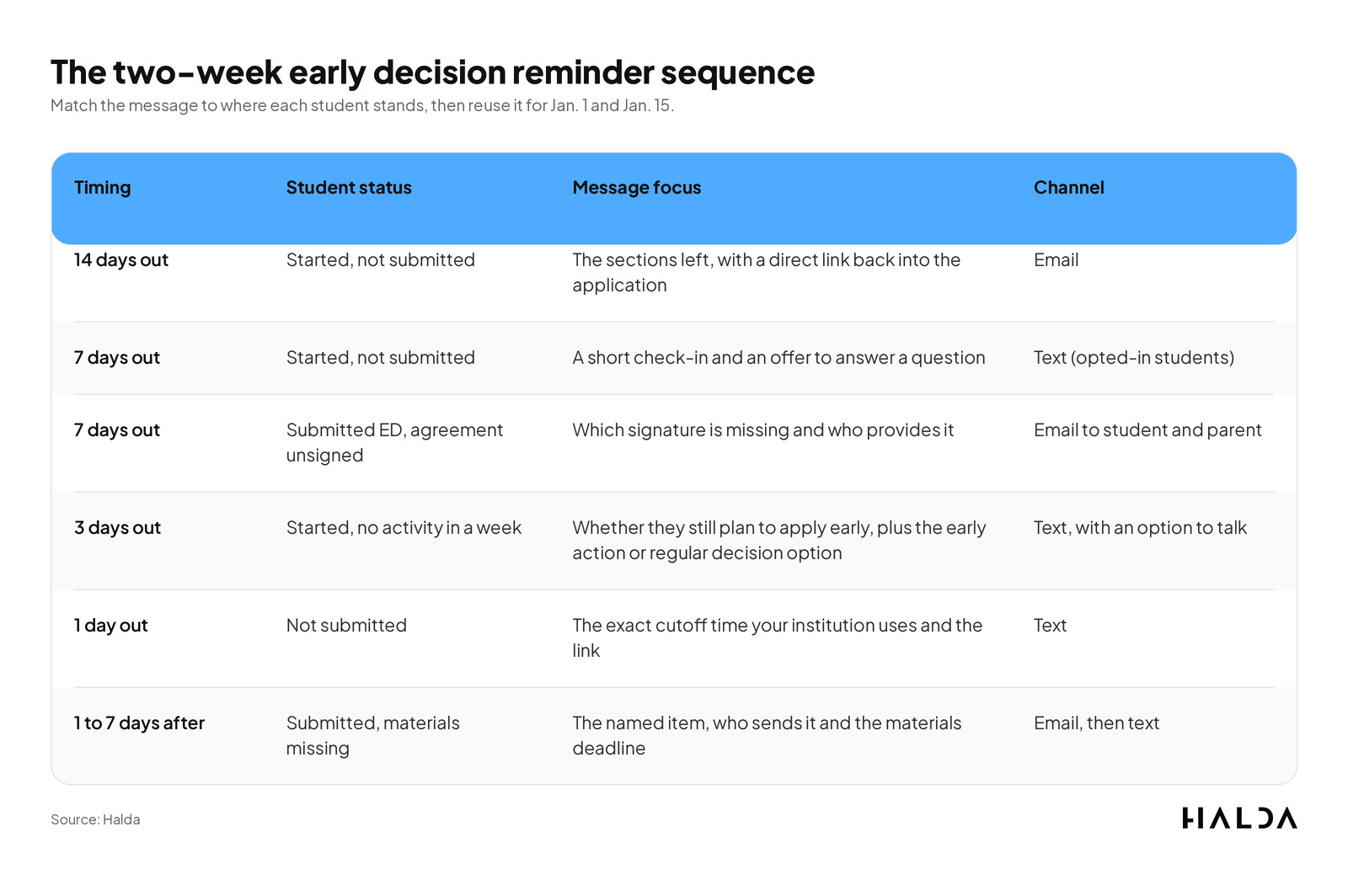
One rule makes the whole sequence feel personal: the reminders stop the moment a student submits. Nothing tells a student you aren't paying attention faster than a "don't forget to apply!" text the morning after they applied.
How do you follow up on missing documents without burying counselors?
Call out the missing item and the person who owns it. A generic "your application is incomplete" message makes a 17-year-old guess what's wrong, and the guess usually shows up in a counselor's inbox as a new question.
Many missing pieces of an early decision file aren't the students’ to submit. The ED agreement needs signatures from the student, a parent or guardian and the high school counselor, and the counselor is often the one who submits it. That's a lot. The rest of the file depends on other people, too:
- The school report, transcript and counselor recommendation come from the high school counselor.
- Teachers submit their own recommendations, usually through the application platform.
- A parent or guardian signs the ED agreement after the student sends an invite.
- At institutions that require it, a financial aid form like the CSS Profile often has its own early deadline.
A better reminder tells the student exactly who to contact and gives them the words to do it: "Your file is waiting on Ms. Patel's recommendation. Here's a two-line note you can forward to her." The student does one easy thing, and your counselor never sees the question.
This works when checklist status flows from your CRM to whatever delivers the nudge. If that connection is manual today, fixing it before Jan. 1 pays off well beyond this cycle. For more on where files stall between started and submitted, see where your applications go to die.
Should deadline nudges go by email, text or voice?
Use each channel for the job it does best, and keep all three in one coordinated thread. A deadline alert, a checklist and a question about aid each belong somewhere different.
- Email works for the checklist, the link back into the application and anything a family will want to reread.
- Text fits the one-day-out alert and the "we're still missing your transcript" follow-up. Our SMS guide for higher ed covers consent and tone.
- Voice helps when a student or parent has a question about the ED agreement or financial aid that won't fit in a text.
Coordination matters as much as the channel. When admissions, financial aid and an athletics coach all text the same student during deadline week, the student feels overwhelmed instead of supported. One thread, one owner and one clear next step are more effective than multiple well-meaning reminders.
How do personalized nudges cut the pre-deadline scramble without adding staff?
Personalized nudges cut the scramble by answering the follow-up question before the student has to email it. A counselor can only give so many students focused attention in a day, so every question a message prevents is time back for the conversations that need a person.
Personalization here means building each message on what the student has already done and asked. A student who asked about merit aid last week shouldn't get the same deadline reminder as a student who hasn't opened anything since September.
Halda is an enrollment platform that learns with every interaction, so each nudge reflects what came before it. In practice, that looks like this:
- An Application Generation campaign starts from your application method, deadlines and required materials.
- Campaign emails pause once a student reaches the funnel stage you choose, such as submitted.
- Test Mode holds real emails for real students in an outbox, so your team can review them before anything goes out.
- Students can request a call, and the AI assistant answers from your content and saves a transcript and summary to the student's record for the counselor.
Halda works with Slate and other CRMs, so your records stay where they are. You can see the latest updates in our August and September release radar.
What should stay human in the last two weeks?
Early decision is a binding commitment, so automation's job is helping students execute a decision they’ve already made. Whether to commit at all is a decision for the student, their family and a counselor.
Set clear escalation rules before deadline week. A person should take over when:
- A family raises affordability concerns about committing before they see an aid offer.
- A student wants to switch from early decision to early action or regular decision.
- Someone needs a fee waiver or describes a hardship.
- A conversation turns personal or sensitive in any way.
These moments are where counselors earn trust, and they're easier to reach when the routine reminders are already handled.
What should you measure during early decision deadlines?
Track four numbers this cycle so you have real answers when budget conversations start in January. Each one shows where files stall and what your team's time went toward.
- Started-to-submitted rate for early decision and early action applicants
- Days from submission to a complete file
- Share of incomplete files by missing item, such as transcript, recommendation or agreement
- Response time to student and parent questions during deadline week
Those four numbers also tell you what to fix before Jan. 1 and Jan. 15. January brings its own surge, and deadline season tends to expose every crack in your follow-up.
Early decision deadline automation FAQ
When are early decision deadlines? Early decision I deadlines commonly fall on Nov. 1 or Nov. 15. Early decision II deadlines usually fall on Jan. 1 or Jan. 15, so the same automation can serve both rounds.
Can admissions offices text applicants about deadlines? Yes, as long as the student has opted in to texts. Keep messages short, identify your institution and include a way to stop messages.
Does automation replace admissions counselors? No. Automation handles repetitive reminders and status follow-up, which frees counselors for the conversations that shape a student's decision.