Marketing Strategy


By Angela Brown, Head of Marketing
A transfer student arrives on your credit page with one question that’s top of mind during the whole visit: will this move me closer to graduation or set me back a semester? If the page answers that question in context, the student keeps going. If it reads like a policy archive, they leave and go ask the school that answered clearly. The goal is to answer first, then offer a low-barrier way to keep the evaluation going, then continue that same conversation outside your website without making the student start over.
The audience justifies the attention. College transfer enrollment grew 4.4% in fall 2024, and transfer students made up 13.1% of all continuing and returning undergraduates, according to the National Student Clearinghouse Research Center. Two-to-four-year transfers remain the largest single pathway at 41.7% of transfer enrollment.
The stakes are just as clear. A U.S. Government Accountability Office analysis of students who transferred between 2004 and 2009 found they lost an estimated 43% of their earned credits, roughly 13 credits, or close to a full semester of work. That figure is historical national data rather than a current benchmark for your institution, and it is nearly a decade old. It still explains the anxiety a transfer student brings to your page.
This post covers the mechanics of one page and what happens in the days after a student leaves it. For the wider strategy, including feeder-school partnerships, segmentation and outreach, read our playbook on how to recruit transfer students in 2026.
Two decisions the credit page has to support
Your site probably lists credit policy, cost and support somewhere already. The credit page has a narrower job, which is turning that policy into a personal answer for the student reading it right now.
Accepted, transferred and applied are three different things
Students conflate all three, constantly. A credit can be accepted by the institution, appear on a transcript, and still end up in the elective bucket where it does nothing for time to degree. Say that difference out loud on the page. Students who understand it ask better questions and trust the answer they get.
Before a student will hand over contact information, they want to see: a searchable course equivalency tool, published articulation agreements, program pathway maps by feeder institution, and a clear route for courses that aren't listed yet. The last one matters more than you’d think. A student whose community college course has no published equivalency will interpret silence as a no.
A labeled planning estimate beats a policy statement
Remaining credits, course sequencing, residency requirements, term availability and prior-learning assessment all determine how long a student has left. Don't promise a graduation date before a formal evaluation. Offer a planning estimate with its assumptions labeled, which is honest and still useful.
Cost belongs beside that estimate, not three clicks away on a general aid page. Transfer scholarships, FAFSA and scholarship deadlines, the financial difference between arriving with an associate degree versus loose credits, and the risk of paying for excess credits all belong in one compact module next to the evaluation request.
Design the page to capture the inquiry, then request contact information
Give the student something useful before you ask for anything. That sequence is the whole design principle, and it's the one most credit pages invert.
Offer two paths:
- Self-service. "Find course equivalencies" or "Estimate how your credits may apply." No form, immediate value, and a behavior you can track.
- Guided. "Request a preliminary transfer plan" or "Talk with a transfer specialist." Higher commitment, higher conversion, human on the other end.
Then collect information progressively, in the order that advances the evaluation: intended major, current or prior institution, approximate credits completed, planned start term. Contact information comes last, and SMS consent is a separate, explicit choice instead of a checkbox bundled with everything else.
Five things belong on the page before any form field:
- A major-specific equivalency search, or a pathway view organized by feeder school
- Plain-language description of how the review works and how long it takes
- An honest line separating a preliminary estimate from an official evaluation
- The full sequence written out: submit, review, receive plan, advisor follow-up, apply
- Transfer outcomes and support evidence, where you have current, attributable figures
That last point has a useful national anchor. NSC's March 2026 Tracking Transfer report found that 81.8% of community college transfer students re-enrolled at their four-year institution the following year, and retention ran 9.2 percentage points higher for students who earned a credential before transferring. Students weighing whether they'll finish respond to that kind of specificity.
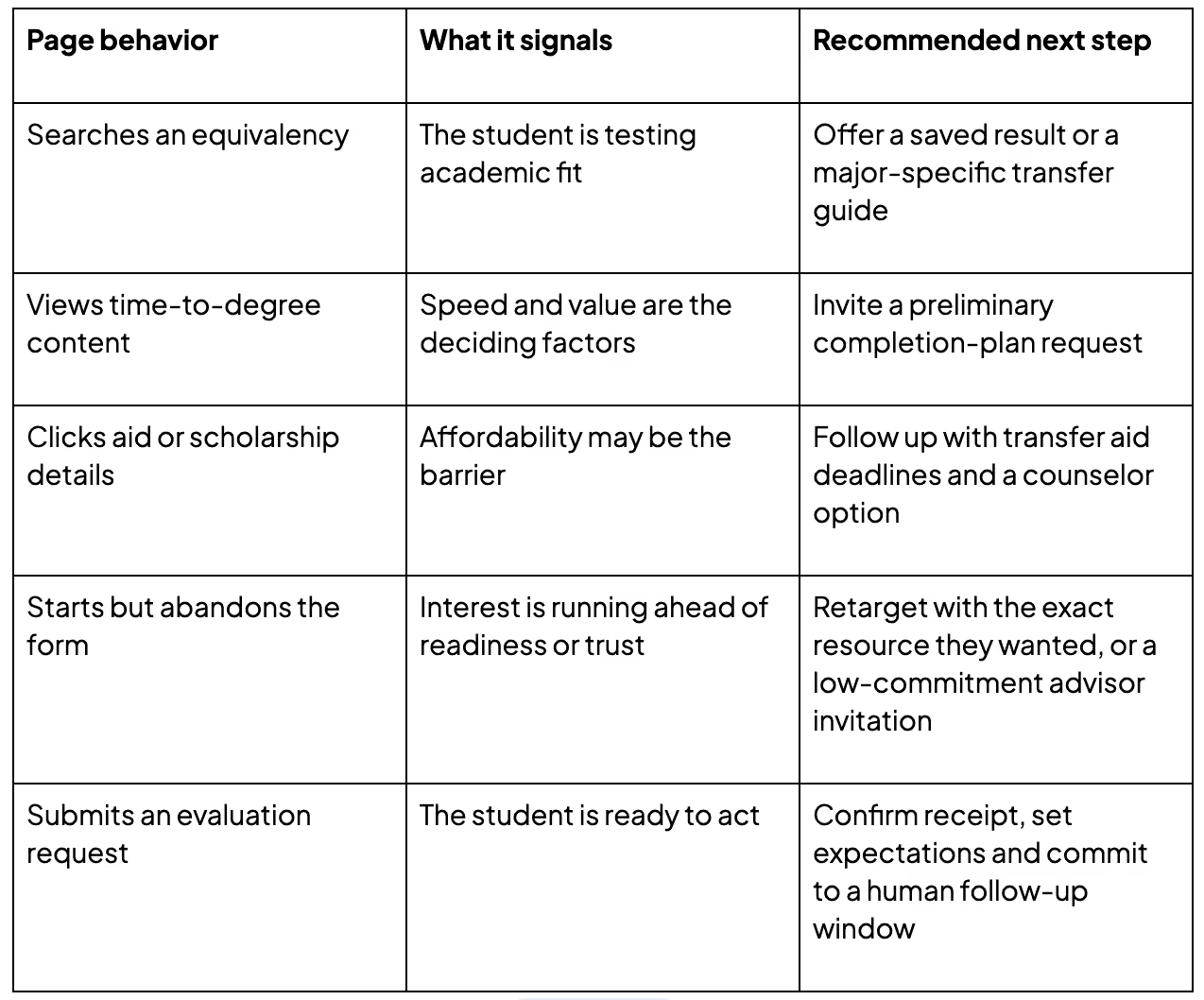
Five behaviors worth acting on
Treat the credit page as a signal source, not a brochure. Each behavior below points to a different unresolved question, which means each one deserves a different follow-up.
.avif)
Carry the same conversation “offline”
Channel orchestration should follow the student's question, not your campaign calendar. A student who spent four minutes on time-to-degree content and never touched aid should not receive a scholarship drip as their first message.
Email carries the detail
Fire the first email immediately after submission. Confirm receipt, restate the major and current institution the student selected, explain the review timeline, and link to the specific equivalency or pathway resource that matches their program. A subject line like "Your transfer credit review for biology: what happens next" outperforms anything generic, because it proves you were paying attention.
Then build the follow-up around whichever question is still open: credits, degree plan, affordability, application readiness. One question per message.
SMS carries the prompt
Text only students who opted in, and reserve it for messages with a deadline or real value attached. An evaluation is ready. A transcript is missing. A transfer deadline is five days out.
"Hi Maya, your preliminary credit review for the BS in biology is ready. Here are your next steps: [link]. Reply STOP to opt out."
Don't use SMS to compress a long email, explain policy or push generic promotions. For more on where texting makes the most sense in the sequence, see our take on what higher ed teams get wrong about SMS.
Keep the context in one place
Pass the declared major, feeder institution, estimated credits, intended term, content viewed and evaluation status into the CRM, and make sure advisors can see the same record. A transfer student who already told your form she's coming from Northern Virginia Community College with 42 credits toward nursing should never have to say it again to a human. Every repeat request is a small withdrawal from a trust account that wasn’t full to begin with.
Measuring whether the page creates progress
Form fills are an activity metric. The question is whether students leave with a credible academic plan.
Track these:
- Credit-page-to-inquiry conversion rate
- Equivalency-search-to-inquiry conversion rate
- Preliminary evaluation request rate
- Form completion versus abandonment
- Median time from request to first substantive response
- Inquiry-to-application rate, and application-to-enrollment yield, for credit-page leads specifically
Then cut the data by feeder institution, intended major, transfer pathway, device and source. Compare students who saw a relevant pathway result against those who only saw generic policy text. Review the most-searched courses with no published equivalency each term, which is both a content backlog and a list of partnership conversations worth having.
Transfer credit page FAQs
What should a transfer credit page include? A searchable course equivalency tool, published articulation agreements, a plain explanation of how credit review works and how long it takes, transfer-specific aid and deadline information, and a clear distinction between a preliminary estimate and an official evaluation.
How do you convert transfer credit page traffic into inquiries? Answer the credit question before requesting contact information, offer both a self-service equivalency path and a guided advisor path, and collect form fields progressively so the student sees value at each step.
What's the difference between credits being accepted and credits being applied? Accepted credits appear on the student's transcript at the new institution. Applied credits satisfy specific degree or major requirements. A student can have credits accepted and still lose time to degree if those credits only count as electives.
When should a transfer inquiry get an SMS instead of an email? Use SMS for opted-in students when the message is short and time-sensitive, such as a completed evaluation, a missing transcript or an approaching deadline. Email handles anything that requires detail or reference.
What metrics show a transfer credit page is working? Credit-page-to-inquiry conversion, equivalency-search-to-inquiry conversion, evaluation request rate, form abandonment, median time to first substantive response, and inquiry-to-application and application-to-enrollment rates for credit-page leads.
Where does the credit page fit in a broader transfer strategy? It's one page inside a larger program that also covers articulation agreements, feeder-school relationships, audience segmentation and outreach timing. Our full playbook on how to recruit transfer students in 2026 covers that ground.
.avif)
________________
As Halda’s Head of Marketing, Angela Brown brings more than 15 years of experience leading marketing and content teams in education and B2B SaaS. When she isn’t at her computer, you can find her reading, watching a true crime documentary, or driving her son to basketball practice.