Enrollment Strategy


By Angela Brown
To recruit transfer students in 2026, you need to build a fast and transparent experience around the four questions they ask before they apply: will my credits transfer, how fast will I hear back, what will it cost and what support comes after I enroll. Answer those questions directly on a transfer page built to convert, segment your outreach by where the student is coming from and measure response speed and conversion instead of raw lead volume. Do that well and transfer becomes one of the more dependable levers you have for filling your class.
The timing is good. College transfer enrollment grew 4.4% in fall 2024, the third straight year of growth, and it now sits 7.9% above fall 2020 levels, according to the National Student Clearinghouse Research Center. Transfer enrollment into community colleges has climbed 13.5% since fall 2020. More students are moving between institutions, and more of them are deciding fast. To capture those students, you need to be the first institution to answer their questions.
What changed in transfer recruitment in 2026?
Transfer is now a growth segment, not a backup plan. The two-year pipeline feeding your four-year programs keeps getting deeper, with transfer-focused public two-year schools posting the largest enrollment gains in their sector this spring, up 5.5% (National Student Clearinghouse, spring 2026).
The behavior driving that growth matters more than the number itself. Transfer students expect faster answers, clearer credit information and more personal guidance than they did a few years ago. About 52% of transfer students last fall had returned to college after dropping out, so many of them are weighing whether to come back at all. A slow or vague response reads as a reason to stay gone.
What do transfer students want to know first?
Transfer prospects ask the same handful of questions, and they ask them early. Answer each one in plain language, near the top of the page, so a student (or an AI search tool summarizing your site) can find it without digging.
Will my credits transfer?
Transfer students weigh credits before anything else, so lead with it. Give a clear path to a credit evaluation, link to any transfer equivalency tool you have and name your maximum transferable credits up front. If you publish articulation agreements with specific community colleges, link them here. Vague language costs you applications, because a student who can't tell whether they'll lose a semester will go ask the school that answered clearly.
How fast will I hear back?
Set an expectation and beat it. Tell students when they'll get a credit estimate and an admission decision, then move faster than you promised. Transfer students often apply close to a term start, so a week of silence can lose them to a competitor who replied the same day.
What will it cost?
Show real net cost, not just the sticker price. Transfer students are price-sensitive and many are paying their own way. Spell out tuition, transfer scholarships, how aid carries over and what a typical transfer student pays after aid. A clear net price estimate beats a tuition table.
What support exists after I enroll?
Name the people and programs that help transfers with a soft landing. Advising built for transfer credits, a clear path into a major, transfer-specific orientation and community all signal that you've done this before. Students reading your page are deciding whether they'll be an afterthought or a priority. Tell them which one.
Build the transfer experience around speed
Speed = enrolled transfer students. Transfer prospects leave when responses are slow or unclear, and they rarely wait around to follow up twice.
Operational readiness is the work here. Tighten transcript review so a student gets a credit estimate within a few days. Get admissions, the registrar and financial aid coordinating off the same timeline so a transfer applicant isn't bounced between three offices. Aim for same-day or next-day follow-up on new inquiries, even if the first reply is just a real human saying "we've got your transcript and here's what happens next."
Design these processes around reducing friction rather than chasing more leads. A smaller pool of transfer prospects who get fast, clear answers will out-enroll a bigger pool that gets stuck in a queue.

Make your transfer webpage the center of the strategy
Your transfer page should do the work of a conversion hub. It's where transfer students often form their first real opinion of you, and increasingly it's the page AI search tools read when a student asks "can I transfer my credits to X college."
Give the page a clear job and the pieces to do it:
- A credit evaluation path or self-service equivalency tool
- Cost and net price information, including transfer scholarships
- Deadlines and a simple, transfer-specific application checklist
- An FAQ that answers credit, cost, timeline and support questions directly
- Easy ways to reach a human, including chat, text and a named transfer contact
Structure the page for both readers and machines. Write your headings as the questions students type, like "how many credits can I transfer," and answer each one in the first sentence or two below it. Add FAQPage schema so search engines and AI tools can read and cite those answers cleanly. Clear, well-structured content is what gets pulled into AI overviews and zero-click results, which is where a growing share of transfer students begin their research.
Segment your audience and match the channel
“Transfer” has several audiences wearing one label. Treat them differently and you'll expand the funnel without buying more leads.
- Current transfer inquiries: people already raising their hand. Move them to a credit evaluation fast and keep follow-up personal.
- Former applicants who enrolled elsewhere: students who chose another school and may be reconsidering after a rough first year. A warm, low-pressure check-in can reopen the conversation.
- Community college students: the deepest pool, especially given the growth in two-year enrollment. Articulation agreements and feeder-school relationships turn this into a steady pipeline.
- Stop-outs returning to school: the 52% of transfers coming back after time away. They need reassurance that their old credits still count and that re-entry is simple.
Reengaging past prospects and activating your articulation agreements are two practical ways to grow transfer volume, and both cost less than net-new lead buys. Geo-targeted digital advertising, retargeting and feeder-school campaigns support that work rather than replace it.
Turn partnerships into an always-on transfer pipeline
Community college partnerships and articulation agreements make transfer recruitment a year-round exercise. A strong agreement with a feeder school means a steady flow of students who already know their credits will move with them.
Make the partnership visible and active:
- Track and publish how many active articulation agreements, feeder institutions and transfer pathways you maintain. It's a number worth reporting internally each year and showcasing externally.
- Put advisors in front of community college students with transfer planning events and on-campus office hours.
- Offer co-branded transfer planning tools that help a student map their route before they apply, so transferring to you feels like the default next step.
Treat these partnerships like ongoing relationships that produce students every term.
Measure what matters
Transfer recruitment success comes down to speed and conversion. Lead count tells you almost nothing on its own. Track the metrics that show whether students are moving through your funnel and finishing the journey.
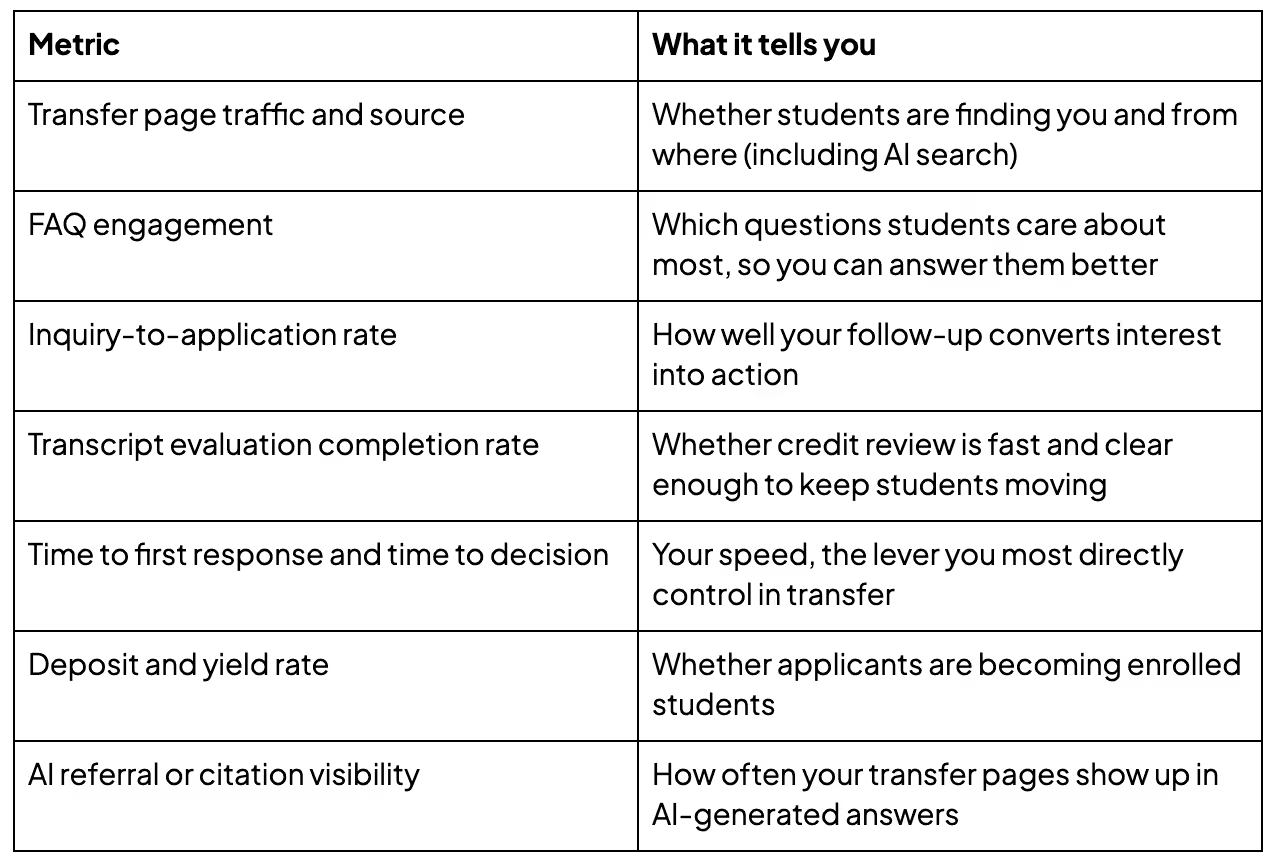
To track that last one, run the questions transfer students ask through the AI tools they use, see whether your pages get cited and check your analytics for referral traffic from AI search. A GEO visibility tracker helps if you have one, but manual spot-checks each term will tell you most of what you need.
Set a baseline for each metric this term, then watch the trend rather than chasing a single number. If you want the report to stay useful year over year, keep a short benchmark table and update it every fall.
How can an enrollment platform like Halda help with transfer recruitment?
Halda is the enrollment platform that learns with every interaction, and it gives transfer teams a way to answer fast when speed is the key to winning or losing the student. When a transfer prospect asks about credits, cost or deadlines on your site, Halda can answer in the moment across web, SMS and voice, then carries that context into the follow-up so the student never has to repeat themselves. Each conversation builds on the last, which lets a two-person team give every transfer inquiry a same-day, individual response without adding headcount.
If credit and cost questions are where you're losing transfer students, that's the first place to see Halda work.
Transfer student recruitment FAQs
What is the most important factor in recruiting transfer students? Speed and clarity on credit transfer. Transfer students decide largely on how many credits they keep and how fast they hear back, so a quick credit estimate and a clear timeline matter more than almost anything else.
How can colleges improve transfer enrollment? Answer credit, cost and timeline questions directly on the transfer page, coordinate admissions, the registrar and financial aid around fast turnaround, segment outreach by student type and measure response speed and conversion. Strengthening community college articulation agreements adds a steady pipeline.
What do transfer students care about most? Whether their credits will transfer, how fast they'll get a decision, what they'll pay after aid and what support exists once they enroll.
What metrics measure transfer recruitment success? Inquiry-to-application rate, transcript evaluation completion rate, time to first response, time to decision, deposit rate and yield. AI citation visibility is a useful newer metric if you can track it.
Why is transfer enrollment growing? Transfer enrollment grew 4.4% in fall 2024, the third straight year of growth, as more students move between institutions and return after stopping out (National Student Clearinghouse). Community college transfer enrollment is up 13.5% since fall 2020.
Angela Brown is head of marketing at Halda, the enrollment platform that learns with every interaction. Enrollment data in this post comes from the National Student Clearinghouse Research Center (Transfer Enrollment and Pathways, Mar 2025; Final Spring Enrollment Trends, Jun 2026). Published Jun 2026.