Enrollment Strategy


By Angela Brown, Head of Marketing
Enrollment teams are planning and placing next year's student search buys right now. The buy itself gets plenty of scrutiny: which vendors, which regions, which test score and GPA bands, how many names. What happens after the names show up in the CRM usually gets far less. In a lot of search programs, every purchased student gets the same email sequence on the same schedule, or one of three or four persona versions of it.
Giving every student their own campaign changes three things. You decide who hears from you first based on where your enrolled students have come from, including places you've never bought. Each student's next message depends on what that student did with the last one. And you can see which purchased names are turning into applicants early enough to change the next buy, while there's still budget left to shift.
Why one sequence for every purchased name stops momentum
A single search sequence treats every name you bought as the same student at the same moment. A junior in a ZIP code that has sent you students for a decade gets the same first email as a junior in a county you've never recruited. The student who opened two messages and clicked on nursing information gets the same follow-up as the student who never opened anything.
Persona tracks help, but only a little. Four versions of a sequence still means each student hears what their group is supposed to care about. What that particular student clicked, asked or ignored doesn't change what comes next, and the schedule keeps running whether they're moving toward an application or have stopped reading.
That has a cost your finance office will eventually ask about. Name buys are one of the most discretionary lines in a top-of-funnel budget, and the pool of names available to buy keeps shrinking. Every purchased student who never hears anything relevant is money spent with little chance of a return, and it raises your cost per enrolled student whether anyone tracks it or not.
Who hears from you first
Start where your enrolled students have come from historically, then look past it. The name buy decides who's in your CRM. It doesn't tell your counselors which high schools to visit first or which students should get a personal note in week one.
Many search buys repeat last year's map: the home state, the neighboring states, a few big metros and wherever inquiries came from last cycle. That map can only confirm where you already recruit. It never tests the ZIP code three counties over that looks a lot like your best feeder region.
Halda Search Modeling scores every ZIP code in the country against your own funnel. The model draws on four kinds of data:
- Your inquiries, applicants and enrolled students by ZIP code, which is the part that makes it specific to your institution.
- Household income, education and employment data, limited to households that are raising children so retirees and empty nesters don't skew a ZIP's profile.
- High school data such as free and reduced lunch rates, per-pupil spending, the share of seniors who file a FAFSA, and access to AP and calculus courses.
- Distance from your campus, plus how your net price compares with the colleges students in that area could choose instead.
From that, the model learns what a ZIP that sends you students looks like and scores the places you've never bought. It counts enrollments on top of applications, so a ZIP full of applicants who never enroll won't rank alongside one that fills seats. When purchased names in a ZIP stop responding, that ZIP's score comes down. Markets with only a few dozen past students lean on the national model instead of guessing from a handful of records, and every market shows how its model performed on a class it was never trained on.
For your first outreach, the scores give your team an order of operations. Counselor travel can start with the highest-ranked high schools, including schools that have never sent you an inquiry. Personal outreach from staff can start with students from your strongest ZIP codes. The scores decide where your team's limited hours go first, since a counselor can only reach so many students personally in a day. Every other purchased student still gets a campaign of their own from day one.
What each student's next message says
Each student's next message should respond to what that student just did. If a student clicked through to your nursing page twice, their next email covers clinical placements and where your nursing graduates work. If they opened two emails and never clicked, the next one tries a different subject and a different reason to care. If they asked about scholarships by text on a Sunday night, the email that follows doesn't make them ask again.
A sequence written over the summer, by your team or a vendor, can't do any of that, because it was finished before a single student responded. Here's how the two compare once purchased names start engaging:
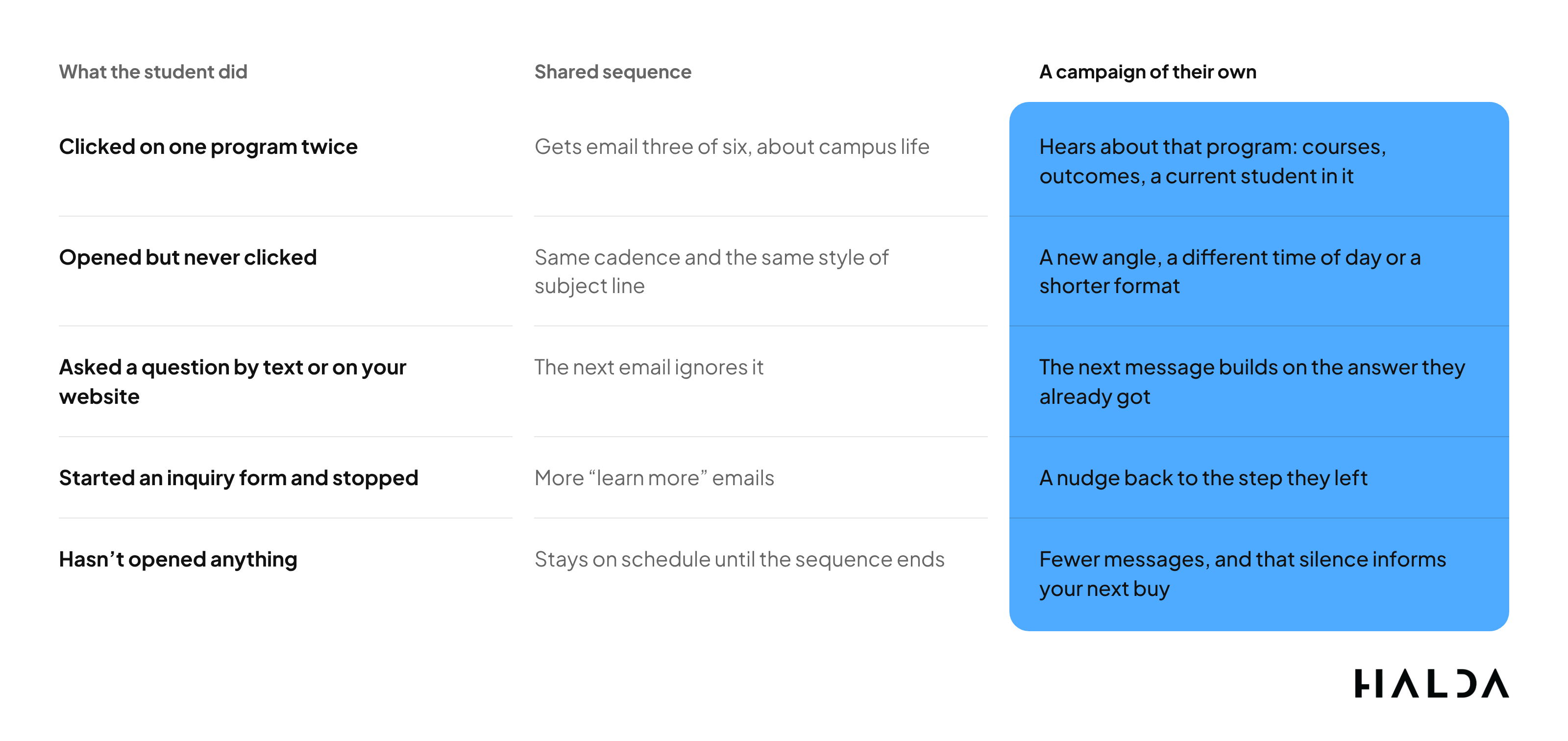
Halda does this for purchased names starting with the first email. It writes to every name you've bought with content matched to that student, and it remembers every interaction across web, email, SMS and voice, so each message builds on the last one. The best-performing campaigns tend to give a student something useful before asking for anything, which is the pattern behind three campaigns our partners ran last cycle. Your team sets the voice, topics and guardrails up front, and Halda handles each student's follow-up from there, so the work doesn't land on your staff one email at a time. Every touchpoint lands on one student record in Slate or Salesforce, so a counselor stepping in can see what the student has read, clicked and asked before saying hello.
A sample student journey
Here's what that could look like in practice. “Jordan” is a composite student, built from the kinds of interactions we just described instead of a specific student’s record.
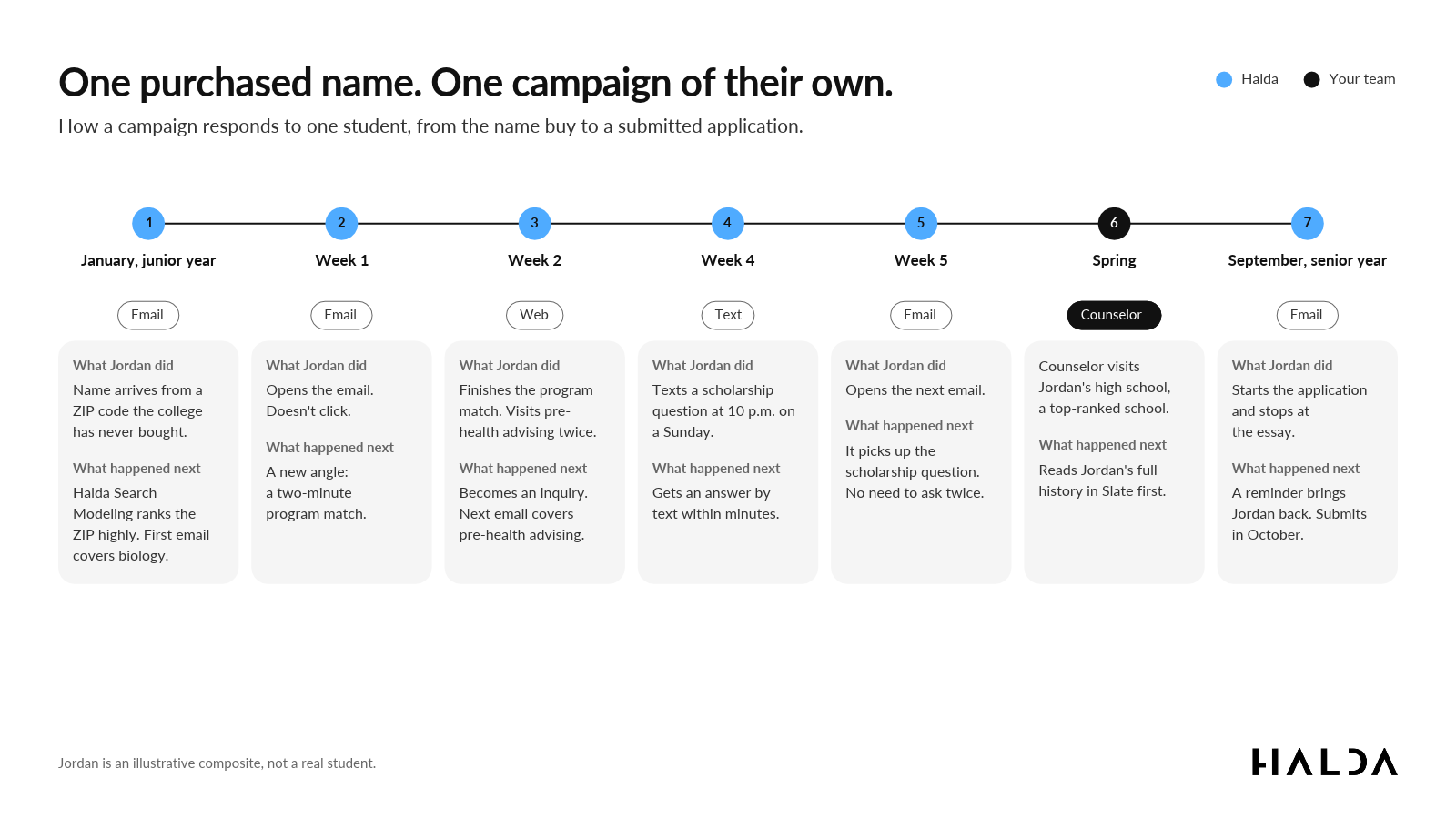
Only two moments on that timeline needed a staff member: the counselor's visit and the conversation that followed. Everything else responded to what Jordan did autonomously.
How to see which purchased names turn into applicants
Follow every purchased name by vendor and by market through inquiry, application and enrollment, and look at it during the cycle and after census. Waiting for fall numbers means the next buy gets placed on last year's guesses. Three questions are worth answering before January.
Which vendors are worth the invoice? Halda Search Modeling's vendor analysis shows how many names from each vendor inquired, applied and enrolled, broken out market by market. A vendor that looks fine in total can still be the weak link in one region.
Is the region weak, or is the list? When names from one area stop responding, the cause could be a poor-fit region, a weak vendor or the wrong student profile. Search Modeling recommends a profile for each market (test score band, GPA band, vendor and majors, using that vendor's own major codes) and shows how confident it is in each pick. That tells you whether to cut a region or change what you buy there.
Where should the next dollar go this cycle? Applications for the current term can be added to the model mid-cycle, and markets can be redrawn without starting over. That matters because students are declaring interest later in the cycle than they used to. If applications lag in February, you'll know which markets and lists to lean on and which to trim.
Those answers also become the case you take to your vice president and your finance office when next year's search budget is set. A line item tied to inquiries, applicants and enrolled students by vendor is far easier to defend than a renewal based on last year's map.
Your checklist before the first message goes out
Use this before names from the new buy start receiving anything. It works whether or not you use Halda.
- Compare this year's market map with last year's. If they match ZIP for ZIP, ask what evidence kept them the same.
- Score at least one region you've never bought against your enrolled students, and decide whether to test it.
- Rank high schools for counselor travel, including schools that have never sent you an inquiry.
- Tag every purchased name with its vendor, list and market so results can be split later.
- Write down what should change in a student's next message after a click, a question, a stalled form and no response at all.
- Decide which student actions bring in a counselor, and make sure that counselor can see the student's full history first.
- Set a mid-cycle checkpoint, ideally before February, to review inquiries and applications by vendor and market.
- Agree now on what evidence would justify cutting or expanding a vendor next year.
Frequently asked questions
What is a student search campaign?
A student search campaign is the outreach a college sends to students whose names it licensed from a list vendor, usually high school sophomores and juniors. Its goal is to turn a purchased name into an inquiry and then an applicant. Search campaigns typically run by email, with mail and digital ads in support.
How is a campaign for each student different from persona-based search?
Persona-based search writes a few versions of one sequence and assigns each student to a group. A campaign for each student changes the next message based on what that student clicked, asked or ignored. Two students in the same persona can receive very different messages by week three.
What is Halda Search Modeling?
Halda Search Modeling is a student search model that scores every U.S. ZIP code by how closely it resembles the places that send your institution applicants and enrolled students. It combines your own funnel data with household and high school data, then tests each market's model on a class it was never trained on. It also ranks high schools for counselor travel and reports how each list vendor's names perform by market.
How is this different from the search model we already use?
Many search models are built once around existing markets and reused for a cycle or more, with little visibility into how much data sits behind each market's scores. Halda Search Modeling scores ZIP codes you've never bought, shows how each market's model performed on a held-out class, and can be rebuilt mid-cycle with current applications. You can also compare several market maps side by side and keep the one that tests best.
Does Halda Search Modeling replace our list vendors?
It doesn't. It works with the vendors you already license from and shows how much of your budget each one has earned. It recommends which regions, score and GPA bands, majors and vendors to buy next, and reports how the names you've already bought are converting.
Does this work with Slate?
Yes. Halda integrates with Slate and Salesforce, so every message, click and reply lands on the student record your team already uses.
What does it cost?
Halda prices to each institution's size and goals instead of a public rate card. A strategy session covers what it would cost for your institution and what the enrollment math looks like against your current search spend.
Decide what happens after the buy before the names arrive
The names you license this fall will start hearing from you within weeks. Whether each student gets a campaign that responds to them, or the same six emails as everyone else on the list, gets decided while the plan is still on the whiteboard. After the first message goes out, you're mostly watching.
To see how Halda Search Modeling builds a market map and reports vendor results, watch the Oct. 22 webinar recording. If you'd rather see it with your own funnel data, book a demo and bring last cycle's buy. Most institutions are live with Halda within 90 days.
________________
As Halda’s Head of Marketing, Angela Brown brings more than 15 years of experience leading marketing and content teams in education and B2B SaaS. When she isn’t at her computer, you can find her reading, watching a true crime documentary, or driving her son to basketball practice.