Marketing Strategy


By Angela Brown, Head of Marketing, Halda
This is a follow-up question we’ve had several times since our last post. With Google AI Mode now serving more than one billion monthly users and Pew Research showing a 46.7% drop in clicks when AI summaries appear, the logic seems pretty clear: why pay for fewer and fewer clicks?
The answer is yes, you should keep paying..with a few caveats.
The budget you had pointed at the top of the funnel six months ago is no longer the spend you need today. But paid search isn't dying, it's being re-sorted.
The paid data is worse than the organic data
While the organic click-loss story is big, the paid story is bigger.
Seer Interactive found that paid click-through rates on queries that trigger AI Overviews fell 68% from mid-2024 to late 2025. Organic CTR fell 61% on the same queries. So while organic is taking the headline beating, paid is right behind it on the same chart.
Meanwhile, paid CPCs are climbing for the same reason. The cross-industry average CPC on Google Search reached $2.96–$4.22 in 2026, the steepest annual increase since 2021, driven by AI Overviews reducing organic click share and pushing more businesses into paid search.
The story for education is worse. Education and instruction advertising costs jumped 41.91% year-over-year from $4.39 CPC in 2024 to $6.23 in 2025, the second-largest CPC increase across all 23 industries tracked.
So institutions are paying more per click for fewer clicks on queries AI is now summarizing in-line. Cutting paid feels like the right instinct, but it's the wrong one. The math doesn't change if you cut your budget, it changes if you reallocate it.
The three-bucket framework
Every Google Ads dollar fits in one of three buckets. The reallocation question is which bucket each dollar belongs in today, not where it was when the campaigns were built.
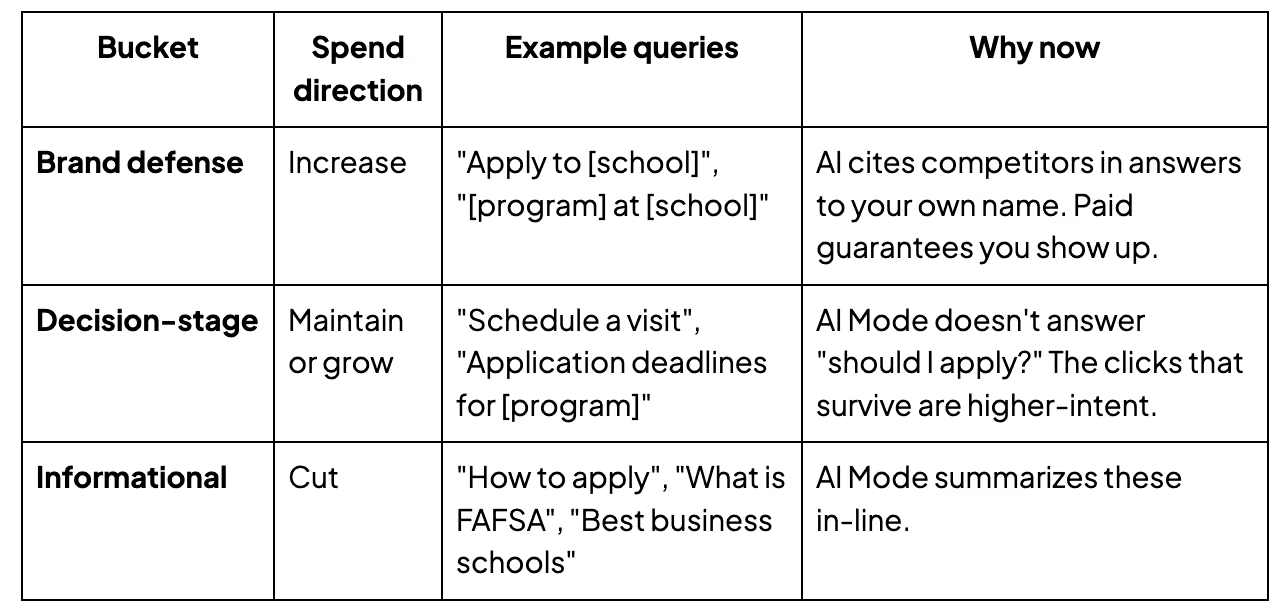
The current allocation across most institutions doesn't reflect this. Vital Design analyzed paid search spend across the ten largest US universities by enrollment using SpyFu data and found the spend breakdown is roughly 63.65% on program keywords (decision-stage), 21.84% on broad keywords (informational), 3.87% on branded keywords, and 10.65% on other keywords.
That 3.87% on branded is the number to remember. The bucket that's becoming more strategically important in an AI Mode world is the one many institutions are spending almost nothing on. Work on that first.

Bucket 1: Brand defense
Paid brand spend was a debate two years ago. Some argued you'd capture those clicks organically anyway. With AI Mode citing competitors in answers to queries that include your name, that debate is over. AI doesn't owe you the top spot just because the query mentions you. Paid brand defense guarantees you show up.
It's also the cheapest insurance you can buy. Dreamdata's analysis of paid search performance found the average CPC for branded keywords was 5.50 EUR versus 21.10 EUR for non-branded, while branded terms generated 1,299% ROAS compared to 68% for non-branded. The ratio holds in higher ed too: branded keywords convert at meaningfully higher rates because the searcher already knows your name.
If your branded campaign is sitting at 4% of total search spend, push it to 10 to 15% before doing anything else. Cap it with negative keywords to keep it efficient, but fund it. This is the single highest-ROI move you can make this summer.
Bucket 2: Decision-stage queries
These are the action-oriented queries at the bottom of the funnel. "Apply to [school]." "Schedule a visit at [school]." "Request info from [school]." "Application deadlines for [program]."
AI Mode doesn't answer "should I apply?" It answers "what is this program?" and "what does it cost?" and "how do I compare options?" Those are the queries getting summarized. The decision queries are mostly intact.
The students who still click paid ads on decision-stage queries are more intent-qualified than they were 18 months ago. AI Mode is filtering casual browsers out at the top. The clicks that survive at the bottom convert at higher rates. WordStream's 2025 data backs this up: Education and Instruction saw the biggest year-over-year increase in conversion rates across all 23 industries tracked, up 43.87%. Higher CPC, but also higher conversion. The dollars per applicant math is actually getting better at the bottom of the funnel.
Bucket 3: Informational queries
This is where the cuts happen. "How to apply to college." "What is a 529 plan?" "What does FAFSA stand for?" "Best business schools in [region]."
These are the queries AI Mode is built to summarize. Paid CTRs on them have dropped 68%. You're paying close to the same cost per click for a fraction of the volume. The math has changed and the channel hasn't adapted yet.
If your account looks like the Vital Design benchmark, roughly 22% of your spend is in this bucket, and that portion needs a new home.
Where to put the reallocated dollars
Two places.
First, more brand defense and more decision-stage spend. Both are now under-priced relative to their intent quality. Increase your daily budget caps on these campaigns first. Test broader match types on decision-stage. Add deeper negative keyword lists to brand campaigns to keep CPCs efficient.
Second, think about the channels AI Mode hasn't touched. YouTube, paid social, display retargeting, and connected TV are largely unaffected by the click-loss story. These channels are doing the top-of-funnel awareness work that informational search used to do. Reallocating a portion of your former informational paid search budget here keeps your full-funnel coverage intact.
As a starting distribution for the reallocated dollars, consider moving roughly 50% to bottom-funnel paid search (split between brand defense and decision-stage), 30% to remarketing across paid social and display, and 20% to YouTube. Adjust based on your historical conversion data, but this is the directional split most institutions should land near.
A note on remarketing. Every dollar of remarketing spend is now worth more because the top of your funnel is narrower. If a student visited your program page once, you want to be in front of them again. Audience pools are smaller, so per-impression budgets stretch further.
The destination is the real multiplier
Here's something you can miss in your standard paid media audit: the argument for keeping paid spend depends entirely on where the click takes the user.
A paid click to a generic program page wastes most of your budget. Unbounce's 2024 Conversion Benchmark Report found higher education landing pages convert at a median 6.3%, near the all-industry baseline of 6.6%. A separate 2026 analysis put higher ed at the lowest-converting industry overall at 2.6%, with the variance driven by destination specificity.
Walk the math with us. Education and Instruction CPCs run $6.23 on average. At a 2.6% conversion rate to inquiry, you're paying roughly $240 per inquiry. At a 6.3% conversion rate, you're at $99. At 17.25%, which is what the University of Montana's persona-based GrizzQuiz hit on the same audience that converted at 4.21% on a generic landing page, you're at $36.
That's the same paid click on the same channel with the same CPC, doing three different jobs depending on where it ends up.
This is the part where Halda fits. Every interaction across the web, email, SMS, and voice builds on the last, so the student who clicks your paid ad doesn't start from zero. They arrive at a destination that already knows what they searched, what they read, and where they are in the funnel. The next touch knows what happened on that one. Your $6 paid click becomes a $36 cost per inquiry instead of a $240 one. That's the difference compounding intel makes.
Your 30-day reallocation plan
Three steps, in order.
- Audit current spend by query intent. Pull the last 90 days of paid search reporting and tag every campaign as brand, decision-stage, informational, or other. Sort by spend. Identify the informational campaigns burning the most budget for the least conversion.
- Reallocate. Cap or pause the bottom three informational campaigns. Push branded campaign spend from 4% to 10 to 15% of total search budget. Move the rest of the freed dollars at roughly the 50/30/20 split above into decision-stage paid, remarketing, and YouTube. Don't put it all back into search.
- Rebuild your top five paid destinations. Generic program pages and homepages have to go. Each top paid destination should have a clear primary CTA, persona-aware content, and a path that doesn't reset every time the student comes back. Section six of our GEO audit template covers this in detail.
The majority of teams can get through steps one and two in a week. Step three is where the real ROI lives, which is also where most teams stop.
What this means for your 2026-2027 plan
Holding your paid budget steady while the channel has fundamentally re-sorted underneath you means spending the same dollars on different click economics. Same campaigns, different math, worse outcomes. That's how a budget that worked last year stops working next year without anyone noticing until applications are down.
The more effective plan is to adjust your budget to grow branded share, hold onto decision-stage queries, cut informational ad dollars, and rebuild destinations to convert the higher-intent clicks they still get. It’s the same paid budget with different ROI.
The headline? Reallocate. Don't cut.
________________
As Halda’s Director of Marketing, Angela Brown brings more than 15 years of experience leading marketing and content teams in education and B2B SaaS. When she isn’t at her computer, you can find her reading, watching a true crime documentary, or driving her son to basketball practice.
.avif)